
Top Ultrasonic Spray Pyrolysis Systems for Thin Film Deposition
2026-10-19
Getting uniform, pinhole-free thin films is still a headache for many researchers and manufacturers. Ultrasonic spray pyrolysis has quietly become a go-to method for depositing oxides, perovskites, and other functional layers because it offers fine droplet control and low-temperature processing. But not all systems are created equal. In this list of top ultrasonic spray pyrolysis systems, we cut through the noise to highlight equipment that actually delivers repeatable coatings. Among the standout names is Siansonic, whose engineering focus on nozzle stability and droplet uniformity addresses the same issues that plague lab-scale and pilot-line work. If you're tired of troubleshooting film roughness or clogged atomizers, read on to see which systems deserve a closer look.
Why Ultrasonic Spray Pyrolysis Beats Traditional Coating Methods for Thin Films
Spin coating and dip coating fall apart once you move beyond small, flat samples. They waste most of the precursor and leave thick rims at the edges. Ultrasonic spray pyrolysis avoids both problems by breaking the solution into droplets only a few tens of microns across. Those droplets are pushed by a low-velocity gas stream onto a heated substrate, so the liquid spreads evenly before the solvent flashes off. Parts with steps, curves, or rough textures get the same coverage as flat areas, without the pooling that ruins traditional wet methods.
A key advantage is what happens before the droplets even hit the surface. The ultrasonic nozzle produces a very narrow droplet size distribution, and that uniformity translates into a smoother wet film. Once the substrate reaches the pyrolysis temperature, the precursor decomposes in place, leaving behind an oxide or sulfide layer that is dense from the start. There are no binders to burn out and no high-vacuum chamber needed to keep the film clean. The result is fewer pinholes and better adhesion than films made with a handheld spray gun or a simple dip coater.
At larger scale, ultrasonic spray pyrolysis remains practical because it operates at atmospheric pressure and uses cheap metal salts dissolved in water or alcohol. A production line can coat meter-wide glass or flexible metal foil without stopping. Changing the film composition is as simple as switching to a different precursor solution, which is far less risky than re-tooling a sputtering system or re-qualifying a chemical vapor deposition process. That combination of low waste, atmospheric operation, and quick chemistry changes gives it an edge in pilot lines and high-mix manufacturing.
Five Workhorse Systems That Deliver Repeatable Thin Film Quality
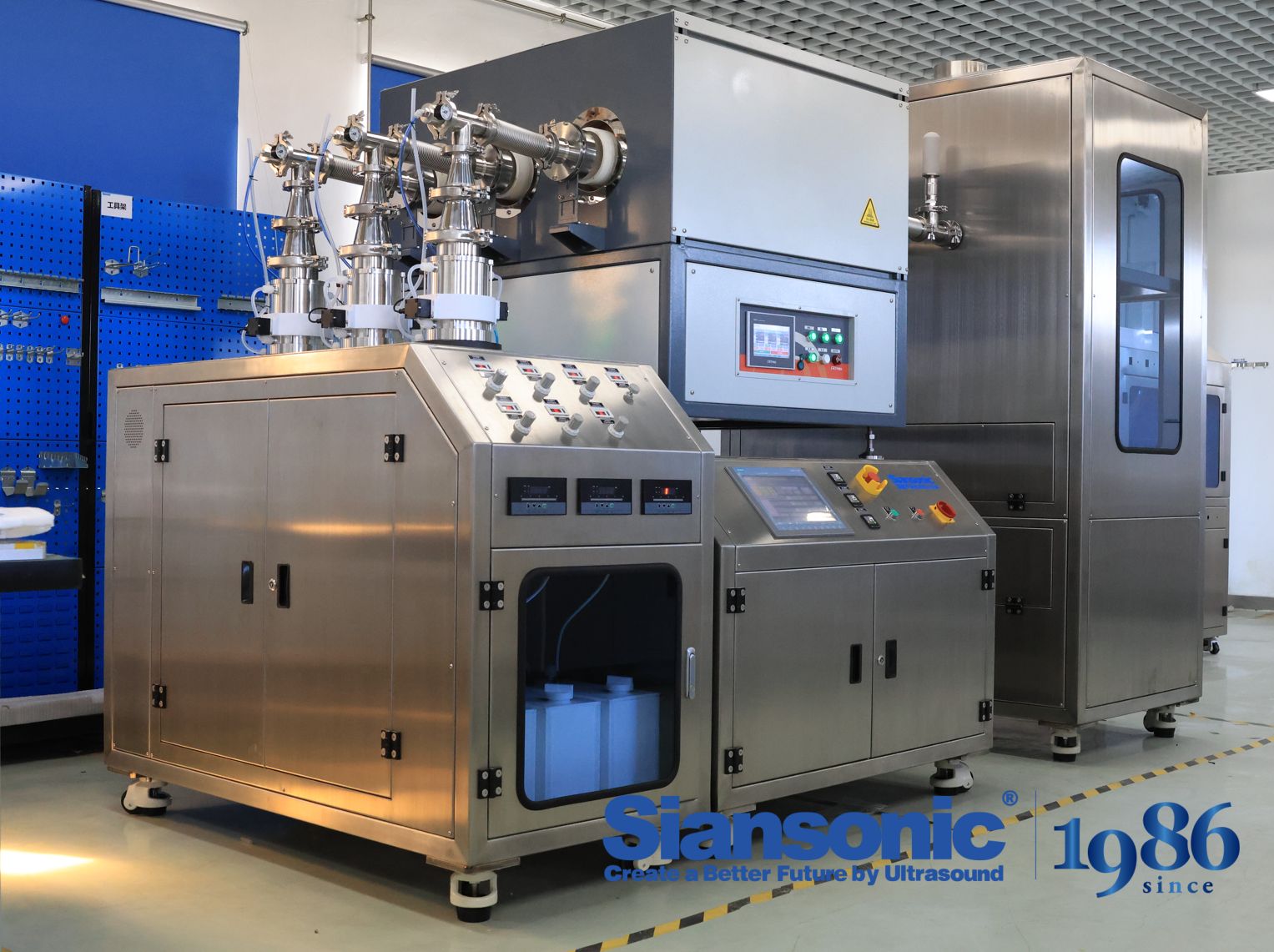
In thin film deposition, repeatability separates production tools from laboratory curiosities. A handful of workhorse systems have earned their place on fab floors by delivering consistent film thickness, composition, and stress run after run. These are not exotic one-offs; they are the dependable platforms that engineers rely on when a process must move from R&D to full-scale manufacturing without surprises.
Magnetron sputtering systems remain the backbone for metallic and dielectric films, thanks to their stable plasma and tight control over deposition rate. Electron-beam evaporators handle high-melting-point materials with minimal contamination, while thermal evaporators keep things simple for lower-temperature metals. For conformal coatings on high-aspect-ratio structures, low-pressure chemical vapor deposition (LPCVD) and plasma-enhanced CVD (PECVD) offer the uniformity that batch production demands.
What makes these systems "workhorses" is not a single breakthrough, but the accumulated engineering around them: closed-loop thickness monitoring, substrate temperature uniformity, and load-locked chambers that minimize particle defects. When you trace a repeatable thin film quality back to its source, it almost always points to one of these five platforms, tuned and maintained by people who understand that consistency is a feature, not an accident.
From Benchtop to Pilot Scale: Systems That Grow With Your Research
Scaling a protocol from a handful of milliliters to dozens of liters usually exposes silent assumptions—mixing times shift, heat transfer behaves differently, and what worked in a flask refuses to cooperate in a reactor. Rather than forcing you to redesign your process at each step, these systems carry the same control logic, sensor layout, and fluid path geometry from bench units into pilot skids. A peristaltic pump calibrated on a 2 L vessel won’t suddenly change its response curve when paired with a 50 L tank, because the hardware and software are treated as one continuous family.
The payoff shows up most clearly during tech transfer. When a downstream team receives a method that already accounts for viscosity changes, gas sparging, and thermal lag at larger volumes, the usual guesswork around parameter translation mostly disappears. You can run the same recipe file, adjust only the vessel-specific constraints, and expect the product profile to stay within range. That continuity cuts months off pilot studies and reduces the chance of a scale-up surprise derailing a promising candidate.
The Hidden Role of Droplet Size in Film Uniformity and How Top Systems Control It
Droplet size rarely gets the attention it deserves when diagnosing film thickness variation, yet it sits at the center of nearly every coating defect. A spray that emits droplets with a wide size range deposits liquid unevenly: the smallest droplets may evaporate before reaching the substrate, leaving behind dry particulate that disrupts the wet film, while the largest droplets arrive with too much momentum and splash or sag. Even a narrow distribution can fail if the mean diameter is mismatched to the solvent's evaporation rate or the substrate's roughness. Uniformity therefore begins not with the coating head or the drying oven, but with how tightly the system controls the size of each individual droplet.
The mechanism linking droplet size to film quality is more subtle than simple mass balance. Smaller droplets have a higher surface-area-to-volume ratio, so they cool faster and evaporate more rapidly, which can trigger localized viscosity gradients and Marangoni flows that pull liquid away from the center of the deposited drop. This is the same physics behind the coffee-ring effect, and it shows up in thin films as edge thickening or center thinning. Larger droplets, on the other hand, retain enough solvent to level out, but their longer drying time gives airborne contaminants more opportunity to embed or cause surface tension-driven mottling. Top-tier coating systems actively narrow the droplet size distribution to a range where neither extreme dominates, often targeting a polydispersity index below 0.1 for critical layers.
Advanced systems achieve this control through a combination of hardware and real-time feedback rather than relying on fixed nozzle settings. Piezoelectric or ultrasonic atomizers can generate droplets with a tightly controlled median diameter, while in-line laser diffraction or phase-Doppler analyzers continuously measure the actual size distribution downstream. If the distribution drifts, the system adjusts flow rate, pressure, or actuator frequency within milliseconds. Some systems also apply a low-level electrostatic charge to the droplets, which prevents coalescence in flight and keeps the size distribution stable until impact. The result is a wet film that levels uniformly across the entire substrate, even on surfaces with complex topography or variable surface energy.
Comparing Build Quality, Temperature Control, and Throughput Across Leading Models
When you put two flagship printers side by side, the first thing you notice isn't the spec sheet—it's how the frame feels when you grab the top rail. Some leading models use thick die-cast aluminum plates that barely flex, while others rely on assembled extrusions that can twist under aggressive acceleration. That rigidity feeds directly into print consistency, especially on tall parts where slight wobble turns into visible layer shifts. It's not just about metal thickness either; the quality of linear rails, belt tensioners, and even the way panels are mounted separates a machine that stays true after hundreds of hours from one that needs weekly re-tightening.
Temperature control is where the gap gets subtle but measurable. Cheaper hotends swing several degrees around the setpoint, and heated beds often have a 5–8°C gradient from center to edge. On better models, you'll find cartridge thermistors with PID autotuning that hold the nozzle within a degree, plus thicker aluminum beds or AC heaters that keep corners from peeling. Throughput then becomes the real differentiator: a printer can only go as fast as its hotend can melt plastic. Flagship units now push 30–40 mm³/s with high-flow nozzles and tuned input shaping, but only if the frame and motion system can handle the acceleration without ringing. Some claim high speeds but fall apart above 200 mm/s; others maintain clean walls at 350 mm/s because the build quality and thermal stability don't fight the speed.
Which Ultrasonic Spray Pyrolysis Setup Fits Your Material and Budget?
The first thing to pin down is how your precursor behaves under heat. Water-based solutions need a longer dwell time and typically a hotter zone to fully crack the mist into oxide particles, while volatile organics can flash off at lower temperatures and leave carbon behind if the airflow isn’t tuned. Match the nozzle frequency and carrier gas to the solvent, not just the target film.
Substrate size changes the math quickly. A 25 mm coupon can run fine on a compact benchtop unit with a single ultrasonic head, but once you move to 100 mm wafers or continuous glass sheets, you need either a scanning nozzle or a multi-head array to avoid thickness gradients. Look at the hot plate’s temperature uniformity across the full platen, not just the setpoint readout.
Budget is less about the base price and more about the extras you’ll actually use. Cheap units often skip the exhaust scrubber, which becomes a problem if your precursor produces acidic fumes or fine particulate. Mid-range setups with a quartz tube reactor and a basic mist trap are the sweet spot for most labs, while full enclosures with gas handling and software recipes only pay off for production runs or highly toxic chemistry.
FAQ
It uses high-frequency vibrations to atomize precursor solutions into fine, uniform droplets, enabling precise stoichiometry control and deposition over large areas without high vacuum, which is crucial for complex oxides.
Lower frequencies (e.g., 48 kHz) produce larger droplets and handle higher viscosity or suspensions, while higher frequencies (120 kHz+) generate finer mist for low-viscosity solutions, improving film smoothness.
Because droplets must evaporate, decompose, and react on the surface; if temperature is too low, solvent residues remain, if too high, premature decomposition in the gas phase leads to powdery films.
Yes, systems with multi-source or sequential injection capabilities allow switching between precursor solutions, enabling doped layers or gradient compositions in a single run.
Mismatched thermal expansion, insufficient substrate cleaning, or overly thick single-pass deposition. Preheating substrates and using multiple thin passes with intermediate drying often improves adhesion.
Low flow can cause droplet coalescence and uneven coverage; high flow may cool the substrate or blow droplets away, reducing deposition efficiency. Optimizing flow helps maintain a stable aerosol plume.
Regular cleaning of nozzle tip to prevent precipitate buildup, checking ultrasonic transducer performance, flushing liquid lines after each run, and replacing O-rings or gaskets that contact solvents.
Metal nitrates, acetates, and chlorides dissolved in water or alcohols are common; they decompose at moderate temperatures. Organometallics with low thermal stability can be trickier due to premature reactions in the mist.
Conclusion
Ultrasonic spray pyrolysis has quietly become the preferred route for researchers who need thin films with tight thickness control and low material waste. Unlike dip coating or spin coating, the ultrasonic nozzle generates a soft mist that lands evenly on heated substrates, so films grow from the bottom up without the streaks or edge beads that plague other methods. The real differentiator across leading systems is how they discipline droplet size: smaller, more uniform droplets flash off solvent before hitting the surface, yielding denser, more homogeneous layers. The best machines pair a stable ultrasonic generator with temperature control that holds the substrate within a few degrees, because even small thermal drift changes nucleation kinetics and ruins repeatability. Five workhorse platforms keep appearing in labs because they balance that thermal precision with rugged plumbing and quick-swap nozzle tips. Some are designed for benchtop use with a single 50 mm substrate, while others accept wider stages and multiple passes, but the core principle stays the same: keep the mist dry enough to avoid pooling, wet enough to promote surface diffusion, and consistent enough that run-to-run variation stays below a few nanometers.
Choosing a system usually comes down to how far you plan to scale. Benchtop units with compact ultrasonic heads are fine for exploratory work on glass or silicon, but pilot-scale tools add heated chucks, larger solution reservoirs, and software that logs every spray parameter. Throughput matters less than repeatability for most thin film work, yet the leading models manage both by using peristaltic pumps that deliver solution at a steady rate even when viscosity shifts slightly with temperature. Build quality shows up in the details: ceramic-coated hot plates resist chemical attack, nozzle bodies survive aggressive solvents, and exhaust shrouds prevent overspray from drifting onto neighboring samples. If your material demands a low processing temperature, you look for a system with infrared-assisted heating or a controlled cooling ramp. If budget is tight, a simpler manual rig can still produce publishable films, provided you monitor droplet size and substrate temperature carefully. The best fit is rarely the most expensive option; it is the one whose thermal and spray parameters you can hold steady long enough to map your process window.
Contact Us
Contact Person: Ivy Zhang
Email: [email protected]
Tel/WhatsApp: +86 1081502288
Website: https://www.siansonic.com/