
TECO Gearmotor Distributor Guide for Sourcing Dependable Drive Solutions
2026-11-25
Datasheets rarely tell you how a gearmotor behaves after two years on a washdown line. That blind spot is exactly why sourcing decisions need more than a spec sheet—and why this TECO Gearmotor Distributor Guide focuses on the traits that keep drive systems running long after installation. It covers what to look for in local support, inventory depth, lead times, and application know-how before you commit to a supplier. For teams comparing dependable drive solutions, Soochee offers a practical option worth evaluating alongside your usual channels.
Mapping Your Torque and Speed Requirements Before Speaking to a Distributor
It happens more often than you'd expect: someone calls a distributor asking for a gearbox, but when the conversation turns to torque and speed, there's hesitation. Those two numbers shape nearly every recommendation that follows. Without them, you're left guessing whether a compact servo unit will hold up or if you actually need a heavier planetary design. Taking an hour to measure your load's peak and continuous torque, along with the operating speed range, turns a vague discussion into a precise one.
Start by listing the worst-case conditions, not just the ideal running point. Acceleration spikes, sudden stops, and occasional overloads often push a drive far beyond its nominal rating. Write down what the machine must deliver in those moments. Then compare that against the speed you need at the shaft, because torque and speed combined define the mechanical power the unit has to transfer. A high-torque, low-speed application might point toward a worm gearbox, while a low-torque, high-speed need could favor a helical inline design.
When you bring these mapped values to a distributor, the conversation shifts from catalog browsing to problem solving. You'll notice better questions about duty cycle, ambient temperature, and mounting orientation come up, because the distributor can now narrow the field instead of offering three different families as a safety net. A simple spreadsheet or even a handwritten note with peak torque, continuous torque, and the rpm band is enough to get started. The goal is not to sound like an engineer; it's to give the person on the other end something concrete to work with.
What Sets TECO Gearmotors Apart in Heavy-Duty and Precision Applications
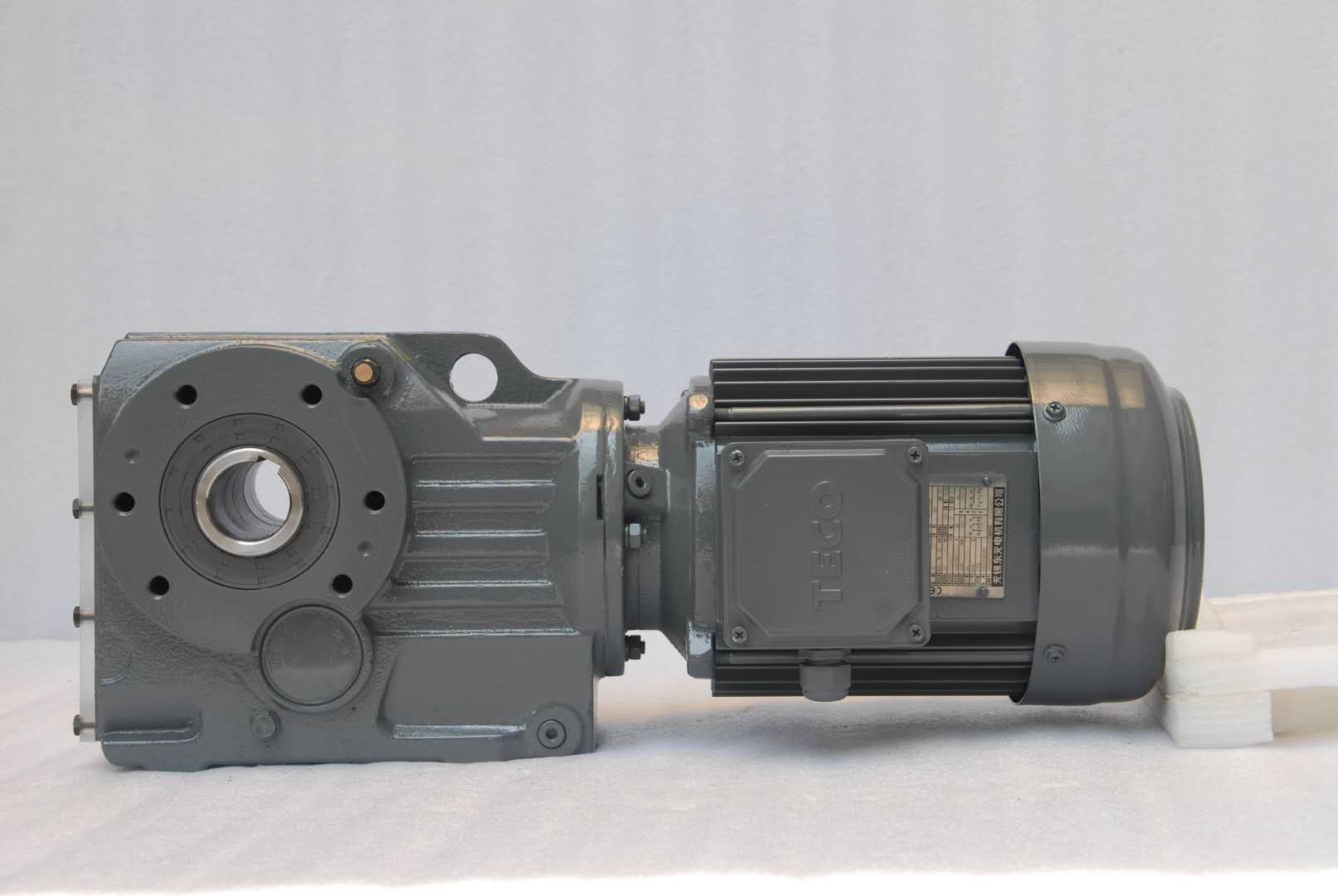
TECO gearmotors for heavy-duty service lean on details that do not always make the cut in generic catalogs. The gear cases are ribbed cast iron rather than thin-wall aluminum, which pulls heat away from the gear set and keeps bearing seats round when a conveyor starts under full load. Oversized shaft diameters and a rigid mounting face reduce deflection, so couplings and sprockets stay aligned longer.
Where precision matters, the difference shows up in the gear tooth finish and the way backlash is controlled. TECO uses profile-ground or skived gearing on many low-backlash models, and the motor feedback options are matched to the reducer rather than treated as an afterthought. That combination shortens settling time on indexing lines and keeps robotic cells from overshooting a target position.
There is also a practical side to the ratings. TECO tends to apply realistic service factors for shock and thermal load instead of relying on a single idealized number, which is why the same frame size can run cooler in a metal-forming line and still hold a tight position on a filling station.
Questions Worth Asking a TECO Gearmotor Distributor Before You Commit
Most purchase conversations start with price and delivery, but a distributor either knows the product line deeply or is just moving boxes. Ask which ratios and brake options they actually keep on the shelf, not just what appears in a catalog. A distributor who can tell you which motor and gearbox combinations survive washdown duty or high-cycle indexing has already proven they work with real applications, not just part numbers.
Lead time matters, but honesty matters more. Ask what happens when the unit arrives with the wrong mounting face or a damaged brake rectifier. A solid distributor will explain the replacement path, whether loaner units are available, and which spare parts are stocked locally instead of pointing to a warehouse three states away.
Finally, ask how they handle after-sales support. Will they help size a replacement for a discontinued frame, or just move you toward whatever is being promoted that month? The answer usually tells you whether you are getting a supplier or a long-term partner.
Reading Between the Lines of Efficiency Ratings and Duty Cycles
A nameplate efficiency figure rarely captures what a machine does between startup, partial load, and shutdown. Ratings are typically established under steady conditions, often at a fixed speed, a standard ambient temperature, or a designated torque band, while real operation swings through idle periods, short bursts, and irregular thermal loads. Reading between the lines means treating the published number as a reference point rather than a prediction.
Duty cycles expose the gap between laboratory conditions and operational reality. Two pumps can share the same nominal efficiency yet behave very differently when one cycles every few minutes and the other runs continuously. Frequent starts, coast-down losses, and low-load stretches often consume more energy than the rated efficiency implies. The useful question is not simply how efficient the component is at its best point, but how that point aligns with where the equipment actually spends most of its working life.
A more honest assessment combines both views: map the duty profile across typical operating hours, then weight efficiency at each load or speed band. This often shifts attention from peak efficiency toward efficiency at the loads that dominate the cycle. It also helps identify mismatches, where a highly rated motor or drive is sized for an occasional peak while everyday operation sits in a less favorable region. The goal is not to discard the rating but to see what it hides once the machine starts moving through its real daily patterns.
Installation, Spares, and Support: Vetting the Local Channel
A distributor’s warehouse can look impressive, but installation quality rarely shows up in a shelf count. Before signing anything, ask to visit a recent job site where their own technicians handled the setup. Watch how the team manages wiring, alignment, or calibration, and listen for whether they adjusted to the actual conditions rather than following the manual step by step. If they hesitate to share a local reference, that usually tells you more than any datasheet.
Spares support deserves the same scrutiny. A full bin of fast-moving filters means little if the odd, expensive component still takes three weeks to arrive. Have them pull records for the last five emergency orders and show the real delivery dates. On the support side, count how many questions it takes before the person answering the phone brings in someone who actually knows the equipment. A local channel is only useful when the first call shortens the path to a fix, not just to a ticket number.
Building a Sourcing Checklist That Keeps Downtime Off the Floor
A downtime event rarely starts with a missing part—it usually starts with a missing name or a forgotten lead time. That is why the most useful sourcing checklists skip broad categories and get down to machine-level specifics. For each critical asset, list the exact component that fails most often, the supplier who actually answers on a weekend, and the real replenishment window, not the one from the original quote.
It also helps to split the checklist into two tracks: one for planned maintenance windows and one for unplanned failures. Planned sourcing can tolerate longer transit times and batch ordering. The unplanned track should only carry actions that can be completed between failure and production impact. If an item cannot arrive inside that window, it does not belong on the response list—it belongs in onsite inventory.
Review cycles matter just as much as the initial build. A checklist written once becomes fiction within a few quarters as suppliers shift, parts go obsolete, and equipment gets modified. Tying the review to a recurring event, such as a quarterly maintenance planning meeting, makes the update feel routine instead of administrative. Keep the format simple enough that a maintenance lead can revise it without needing a purchasing background.
FAQ
Look for someone who asks about ambient temperature, duty cycle, overhung load, and how the reducer will be mounted. A capable distributor will confirm service factor and thermal capacity instead of quoting the lowest price first. If they do not bring up these details on the first call, you are probably dealing with an order taker.
Oversizing feels safe but often leads to higher purchase cost and larger frame sizes that complicate mounting. Start with the actual torque at the output shaft, then apply a realistic service factor for shock loads and starts per hour. A good distributor will help you review the torque curve rather than pushing a larger horsepower number.
Ask what they keep in local inventory, not what their supplier lists as available. Then ask how they handle a failed reducer that has to be replaced mid-week. The answer should include specific freight options, regional warehousing, and a clear path to a drop-in replacement, not just a promise.
Provide the driven equipment type, operating hours per day, starts and stops per hour, ambient conditions, and the exact mounting orientation. Also include whether the motor needs a brake, encoder feedback, or washdown duty. Missing details often result in a quoted unit that looks cheaper but cannot hold up.
Watch for vague answers about warranty processing, no local technical contact, and an inability to supply repair parts like seals, bearings, or gaskets. If they cannot describe how a warranty claim moves from inspection to replacement, the long-term support is likely weak.
Do not compare only the unit price. Put the quotes side by side with the same service factor, the same efficiency class, the same brake torque, and the same paint or sealing option. Confirm whether each quote includes a complete unit or a bare reducer plus a separate motor. Also check who covers freight and what the stated lead time actually means.
It makes sense when the shaft size, mounting face, or motor voltage must match existing equipment without modifying the machine. Custom can also be the better route for odd mounting angles, high ambient heat, or specific sealing requirements. If an off-the-shelf unit requires adapters and field modifications, a configured assembly is often cheaper in total installed cost.
Conclusion
Sourcing a dependable TECO gearmotor means doing the homework that most conversations with a distributor skip. Work out the real torque demand at the gearbox output, not just the motor nameplate, and be clear about how often the drive starts, stops, or holds load. Those details change the selection more than horsepower alone. TECO units tend to stand out where duty is unforgiving—frequent reversals, high ambient heat, or prolonged low-speed operation—so the distributor should be able to explain why a particular frame, ratio, and brake option matches those conditions instead of simply quoting a catalog number.
When comparing options, push past headline efficiency figures and ask what they assume about duty cycle, ambient temperature, and service factor. A unit that looks efficient on paper may be undersized for the way your line actually runs. The local channel matters just as much: check whether the distributor stocks or can quickly source seals, brakes, fans, and mounting kits, and whether their support people have seen real field failures rather than only order entries. Before committing, run through a short checklist—torque and speed verified, thermal limits checked, spare parts lead times confirmed, and a clear escalation path for commissioning or troubleshooting. That discipline keeps a gearmotor selection from turning into unplanned downtime on the floor.
Contact Us
Contact Person: Jenny Jaa
Email: [email protected]
Tel/WhatsApp: 0086 152 9510 6006
Website: https://www.china-motor-supplier.com