
Shoe Eyelets Exporter Tips for Choosing Quality Hardware
2026-11-02
Every pair of shoes tells a story, but only quality hardware keeps that story from falling apart. If you're sourcing shoe eyelets from an exporter, the difference between a satisfied customer and a costly return often comes down to details most buyers overlook. That's where Kingming steps in — not with another generic checklist, but with field-tested insights that separate durable brass from cheap imitations. In this guide, we skip the fluff and focus on what actually matters when choosing a hardware partner, from plating thickness to punch consistency. Read on before your next order, because your shoes deserve better than a weak link.
Brass or Stainless? Matching Eyelet Metal to the Shoe's End-Use
Eyelet metal isn’t just a visual detail—it changes how the shoe behaves under stress. Brass, being softer and more malleable, seats smoothly against leather and develops a dull patina over time. That makes it a natural fit for dress shoes and everyday casual footwear where the eyelets won’t face constant abrasion or moisture. The trade-off is that brass can deform if laces are yanked hard or if the shoe gets dragged through rough conditions.
Stainless steel, by contrast, holds its shape under heavy tension and shrugs off salt, sweat, and water without corroding. You’ll see it on work boots, hiking shoes, and marine deck footwear for good reason—these environments punish softer metals quickly. The downside is that stainless eyelets can feel harder against thin leather and sometimes produce a sharper edge, so they’re less common on refined dress shoes unless the design intentionally leans rugged.
Plating Thickness: The Micron Number That Separates Rust-Free from Repaint Jobs
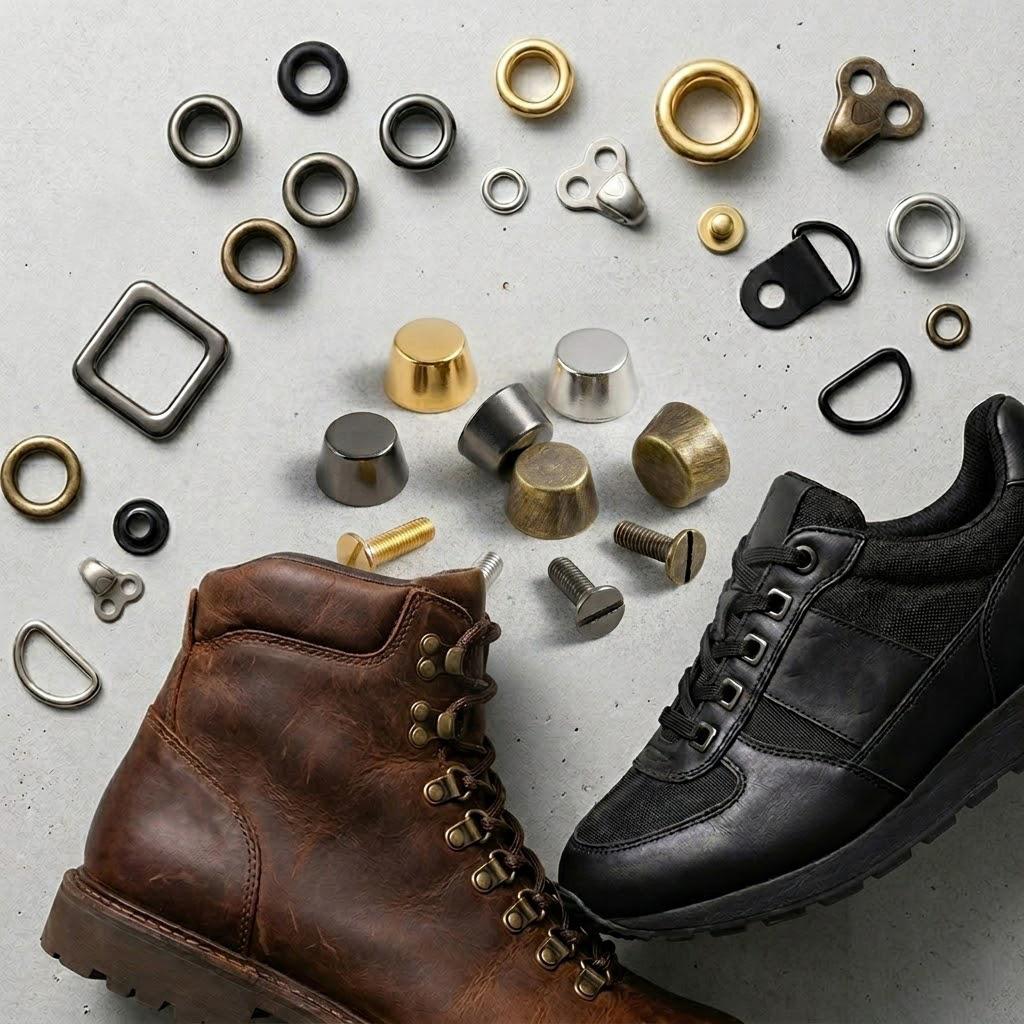
A few microns of plating can mean the difference between a part that shrugs off years of road salt and one that starts bubbling within months. The thickness of electroplated zinc, nickel, or chrome is not just a spec sheet number—it dictates how well the coating sacrifices itself to protect the base metal. In practice, rust prevention hinges on having enough sacrificial material to corrode before the underlying steel even thinks about oxidizing. Too thin, and the plating wears through at edges and fastener threads, exposing bare metal. Too thick, and you risk cracking, poor adhesion, or wasted material. The sweet spot is often narrower than a human hair, which is why precision control matters far more than most realize.
Different environments demand different micron ranges. A decorative interior trim piece might get away with 5–8 microns of nickel, while a structural bolt meant for coastal or de-icing salt exposure needs 25 microns or more of zinc. Hard chrome on hydraulic rods often runs 20–50 microns to resist both wear and corrosion. But raw thickness alone is not enough—distribution across complex geometries is where many jobs fall apart. Sharp corners, recesses, and threads tend to plate thinner due to current density variations. Skilled platers compensate with conforming anodes, pulse plating, or auxiliary cathodes, because a uniform 15-micron layer will outperform a lumpy 25-micron one every time. Measuring with X-ray fluorescence or coulometric thickness testers catches these hidden weak spots before they become field failures.
Repaint jobs often trace back to plating that was just barely out of spec, or uneven in the wrong places. A fender that rusts through from the inside typically had its inner cavity plated to only a third of the outer surface thickness. Likewise, fasteners that look perfect on the shelf can corrode under the head or inside the thread root, where plating thins out. The micron number on the inspection report is not a formality—it is the earliest warning system for whether a component will stay clean or come back as a warranty claim. For anyone tired of sanding down rust blooms and repainting, paying attention to plating thickness distribution beats adding another topcoat every single time.
Barrel Height vs. Upper Thickness: A Fit Check Most Exporters Skip
A lot of overseas suppliers will list barrel height down to the millimeter, yet never mention how the upper leather actually wraps the leg. Barrel height alone won’t tell you if a boot pinches at the calf or gaps at the ankle. The real fit check is comparing measured shaft height against upper thickness at three points: the collar, the widest calf curve, and just above the instep. Miss that, and you’re left with returns from customers who can’t zip the boot past mid-calf.
We’ve seen tall boots with a 38cm shaft that fit terribly because the upper was cut too straight, with no allowance for muscle taper. A quick fix is to lay the boot flat, measure the upper across the widest part, and double that number. If that figure is less than the rider’s calf circumference plus a finger’s width, the fit will fail even if the barrel height matches the spec sheet. This is the kind of check that separates a ‘looks right’ sample from one that actually works.
The Burr Test: How to Spot Cheap Stamping Before It Reaches Your Customer
A burr is the little ridge of displaced metal left along a stamped edge. It tells you a lot about tool condition and process control. Run a clean fingertip—or better, a cotton glove—across the cut edge. If it catches, that’s your first red flag. Cheap stamping shops often skip the deburring step or let dies run dull until burrs become obvious.
Look closely at inside corners, holes, and narrow slots. Those areas wear unevenly and produce burrs that are easy to miss in a quick visual check. Use a 10x loupe or pocket microscope. Compare both sides of the part: a proper stamping process usually produces a slight burr on one predictable side, not random jagged edges.
The burr test isn't just cosmetic. A sharp edge can cut assembly workers, damage mating components, or cause premature fatigue cracks. If the burr height varies from batch to batch, that's a sign of poor die maintenance. For parts that will be plated or painted, burrs also create adhesion problems later. So before a cheap stamping reaches your customer, run this simple check at incoming inspection.
Salt Spray Hours: Why 24 Hours Is Not Enough for Marine Footwear
When a marine boot claims to pass a 24-hour salt spray test, it sounds reassuring on a spec sheet. But anyone who has actually spent a season on deck or a week working the docks knows that salt water doesn't stop at the 24-hour mark. The problem is that standard salt spray tests are designed for general metal coatings, not for the constant wet-dry cycling, abrasion from sand and ropes, and the slow creep of brine into seams and eyelets that marine footwear faces. Twenty-four hours of mist in a controlled chamber barely scratches the surface of real exposure, where a boot might see a hundred cycles of soak and dry, each one driving salt crystals deeper into the stitching and hardware.
Consider the environments where marine footwear actually lives. A fisherman's boot gets hit with salt spray at dawn, then bakes under a noon sun, only to be soaked again when the deck washes down. That cycle repeats daily for months, not for a single day. The 24-hour test gives a snapshot, but it misses the cumulative damage that occurs when salt residues draw moisture from the air, keeping the material damp long after the visible water is gone. This is why hardware that passes a one-day spray test can still show green corrosion around grommets or a weakened bond between sole and upper after just a few weeks of real use. The standard simply wasn't built to predict that kind of fatigue.
Forward-thinking manufacturers are moving toward longer, more realistic test protocols—72 hours, 96 hours, even 200-hour cycles with intermediate drying phases. These extended tests reveal what a single day cannot: how threads wick salt into hidden areas, how leather or synthetic uppers stiffen and crack after repeated salt loading, and whether the metal components are truly marine-grade or just coated for a brief show. When you see a boot marketed as "salt spray tested," ask for the full picture. Twenty-four hours is a starting point, not a finish line. For footwear that needs to survive the relentless assault of the ocean, only extended cyclic testing tells you whether it will hold up through the season, not just through the afternoon.
Crimp Without Cracks: Testing Flange Integrity on the First Shipment
Before any flange leaves the dock on a first shipment, the real test isn't just whether the crimp looks tight—it's whether it can survive the micro-movements and pressure spikes that don't show up on a standard gauge. We start by pulling samples from the middle of the production run, not the ends, because that's where die wear tends to bite hardest. Each one gets a slow, deliberate cross-section cut and a dye-penetrant check that exposes hairline fractures long before they'd ever see a torque wrench.
The trick is to test the flange as a system, not just the crimped collar. We mount it on a fixture that mimics the actual mating surface it'll meet in the field, then cycle it through low-level vibration while holding pressure just above the rated working limit. Cracks love to hide under the plating or behind the bolt holes, so we alternate between thermal shock and a gentle flex test. A good crimp won't whisper, but a bad one will—if you listen with the right equipment, that is.
For the first shipment, we don't rely on a single pass/fail number. Every flange gets a serialized record tied to the die set and the operator's shift, so if one crack shows up later, we can trace it back to the exact moment it was created. It's slower, sure, but it beats getting a call from a customer who just found a weep on a cold morning. The goal isn't to prove the flange is perfect—it's to prove we caught every flaw before the crate was sealed.
FAQ
Look closely at the base metal. Brass and stainless steel tend to hold up far better than low-grade zinc alloys, especially in humid shipping conditions. Ask for a mill certificate or composition sheet rather than relying on verbal claims.
Request a salt spray test report. A decent electroplated or powder-coated eyelet should withstand at least 24 to 48 hours without visible corrosion. Also ask about the coating thickness—thin flash plating often rubs off before the goods reach the buyer.
Yes. Barrel length and inner bore diameter matter more for assembly. If the barrel is too short for the material thickness or too narrow for the laces, the eyelet fails even if the flange looks perfect. Always match these against the actual shoe panel samples.
Watch for inconsistent barrel heights in the same batch, burrs around the flange edge, and uneven plating color. These indicate worn tooling or rushed polishing. A reliable exporter should have gauges and go/no-go fixtures at the production line, not just final inspection.
Avoid the cheapest quote if it skips on plating thickness or uses recycled mixed scrap metal. A mid-range price with traceable raw material and a clear warranty on finish often costs less in the long run than replacing rusted eyelets or losing a retail client.
They can if the tooling is not maintained. Deep engravings or unusual flange shapes may create stress points or trap moisture. Ask for pre-production samples and a small pilot run to verify that the custom design does not compromise barrel strength or coating adhesion.
Specify acceptable defect limits, test methods like salt spray hours and pull-out force, and the exact material grade. Also include the right to reject entire lots if plating thickness falls below the agreed minimum. This keeps both sides clear before production starts.
For work boots, hiking shoes, or children’s footwear, yes. Reinforced barrels resist pull-out and deformation under repeated lacing tension. For lightweight fashion shoes, a single-layer brass eyelet with good plating is usually enough, so spending more adds no real benefit.
Conclusion
Eyelet selection isn't a one-size-fits-all call; it begins with material and geometry that match how the shoe will actually be worn. For work boots or marine footwear, stainless steel makes more sense than brass once salt and moisture enter the picture, while brass can be the right economical choice for casual or indoor styles where corrosion risk stays low. But even stainless fails early if the plating is too thin. Aim for a plating thickness measured in microns that lines up with your target market's humidity and wear expectations—thin flash plating might pass a visual check but starts showing rust or dulling within months. A quick burr test along the eyelet's inner edge reveals whether the stamping process was cheap; any roughness there will shred laces and trigger returns.
Fit is just as critical as surface finish. Compare barrel height against the upper's total thickness before ordering, since a barrel too short won't clinch properly and one too long will crack or protrude through the lining. This is a fit check many exporters skip until the first claim arrives. On corrosion testing, 24 hours of salt spray is a bare minimum that tells you almost nothing about marine footwear; demand longer cycles or cyclic corrosion tests that mimic wet-dry exposure. Finally, pull a sample from the first shipment and test flange integrity under crimping pressure—look for micro-cracks with magnification rather than trusting the naked eye. Catching those cracks now saves a container of returns later.
Contact Us
Contact Person: Jamie Zeng
Email: [email protected]
Tel/WhatsApp: +86 13728219269
Website: https://www.kmhardware.com