
Sand and Gravel Separator Chute Solutions for Maximum Material Recovery
2026-08-22
Every ton of sand and gravel lost through an inefficient chute eats directly into your bottom line. That's why Sinou has focused on chute geometry, liner materials, and flow dynamics to squeeze more recoverable material from every pass. In this guide, we’ll look at practical ways to upgrade your separator chute for maximum material recovery—without the usual trial-and-error.
Fine-Tuning Chute Inclination for Higher Material Retention
In bulk handling, chute inclination often starts from a generic 37° to 45°, but that baseline rarely survives contact with real material. Retention increases when the slope is tuned so that the material's angle of repose plus a safety margin keeps the stream moving without accelerating into turbulence. For lignite or wet clay, even 50° can stall, while dry aggregates may retain well at 35°. The key is to measure the actual sliding friction on the liner, not rely on published values, because liner wear, surface rust, and moisture create local stick points that reduce effective retention.
A practical approach is to divide the chute into zones: a steep initial section (50–65°) to overcome static friction after impact, a mid-section adjusted to the measured wall friction angle, and a shallow discharge section (10–20° below the material's angle of slide) to slow the stream and build a retained layer. The retained layer, often a few centimeters thick, protects the liner and stabilizes the flow path, but it only forms when the inclination allows fines to settle out of suspension without causing blockage. We have found that adding a 2–3° micro-adjustment at the transition points often yields a 15–20% increase in retained material without increasing spillage.
Fine-tuning is not a one-time calculation. Temperature swings, rain, and changes in feed size distribution shift the effective friction angle by several degrees within a single shift. Operators should install adjustable wear liners or wedge inserts at the lower third of the chute, not at the top, because that is where the retention layer either forms or collapses. A simple test: if a handful of material placed at the mid-chute remains stationary for more than 2 seconds, the angle is too shallow for that moisture condition; if it skids to the bottom without leaving any residue, the angle is too steep and retention will be low. Incremental 1° changes, followed by observation over a full production cycle, produce better retention than any fixed design table.
The Cost of Ignoring Chute Wear in Aggregate Processing
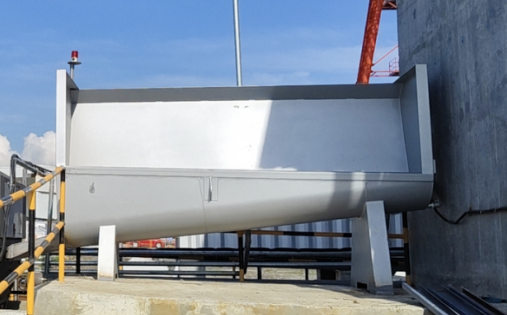
In aggregate processing, chutes guide abrasive material from crushers to screens and stockpiles. When wear is ignored, liners thin, holes develop, and material starts eating into structural steel. The immediate result is unplanned downtime—operators must stop the line to patch or replace a chute that could have been scheduled for maintenance.
The financial hit goes beyond the repair itself. A worn chute leaks fines and aggregate, creating cleanup labor, lost product, and potential contamination of surrounding grades. More critically, uneven flow caused by holes or distorted plates can overload one side of a screen or belt, accelerating wear on downstream equipment. Those secondary failures often cost several times more than replacing the chute liner would have.
Safety risks also climb. Spilled material around walkways and under conveyors creates slip and trip hazards, while a sudden chute collapse can send heavy steel and rock into work areas. By treating chute wear as a routine inspection item rather than an emergency, operators avoid the cascade of repair costs, production losses, and safety incidents.
Damp Feed, Steep Chutes, and the Recovery Trade-Off
Running a steep chute with damp feed rarely feels like a clean win. The extra slope keeps material moving, but wet fines start clinging to the liners in uneven patches. Operators often compensate with more wash water or a sharper angle, and before long the chute is wearing unevenly and the feed rate swings. That is the hidden cost: what you gain in hang-ups, you give back in turbulence.
A few plants have shifted toward hybrid liners and slightly reduced angles, accepting occasional slowdowns to protect the downstream separation. The feed remains damp, yet the discharge comes out more stratified, which helps the recovery circuit. Pushing the chute past 70 degrees rarely fixes stickiness; it just moves the problem further down the line.
The recovery trade-off shows up when the belt cut or sampler catches a surge of coarse material instead of a representative slice. Steep chutes can accelerate the load enough to bypass a portion of the fine fraction, especially with damp agglomerates. Tightening the angle back to 65 degrees and adding a small impact plate often stabilizes the split without inviting blockages.
Redirecting Splash Zones to Stop Fines From Bouncing Out
Redirecting splash zones is a practical fix many shops overlook when fines keep bouncing out of the grinding chamber. Instead of letting the spray ricochet straight back into the operator's path, a simple angled deflector or a curved shield can send the particles toward the collection tray. This small change reduces cleanup time and keeps the workspace safer without needing a full machine redesign.
Another approach is to adjust the nozzle position so the coolant or slurry hits the wheel at a shallower angle. By doing this, the fine particles are carried downward rather than outward, which means less material bounces off the guard and lands where you don't want it. Some operators also add a second, adjustable splash plate that can be fine-tuned for different wheel speeds and feed rates.
Finally, a simple rubber flap or brush strip mounted at the exit edge of the guard can catch the last bits of spray that try to escape. This flexible barrier doesn't interfere with the workpiece but stops fines from shooting past the containment area. Combined with a slight change in coolant flow direction, these redirects often solve the bouncing problem without expensive add-ons.
Retrofitting Older Separators With Modern Chute Liners
Older magnetic and density separators often keep running well past their original design life, but their feed and discharge chutes rarely receive the same attention. The original mild steel liners wear thin, develop holes, and create ledges that disrupt material flow. Retrofitting these chutes with modern ceramic-embedded rubber or high-alumina tile liners changes the wear profile almost immediately. The smooth, impact-resistant surface keeps ore or aggregate moving at the intended speed, reducing spillage and the constant patch welding that eats into maintenance hours.
A common retrofit starts with a 3D scan or careful manual measurements of the existing chute, because older separators often have slightly warped or patched sections that no longer match factory drawings. Modular polyurethane and ceramic panels can be trimmed on site to fit these irregular shapes without rebuilding the entire chute. For high-impact zones near the feed point, ceramic-imbedded rubber absorbs the shock while the hard ceramic face resists gouging. In wet or sticky applications, low-friction polyurethane liners prevent material from clinging and building up in corners.
The payoff goes beyond longer liner life. When chute surfaces stay smooth and the original flow angle is maintained, the separator sees a steadier, better-distributed feed. This directly improves separation efficiency and cuts the frequency of unplanned downtime. For plants that cannot justify a full separator replacement, a well-planned chute liner retrofit delivers a meaningful portion of the performance gain at a fraction of the capital cost.
Reading Wear Marks to Predict Where Material Is Being Lost
On any machine that handles abrasive slurries or dry bulk solids, the first sign of trouble often shows up as a polished groove or a thinning wall. Instead of waiting for a leak or a structural failure, maintenance teams can map these visual cues back to flow dynamics. A wear pattern that deepens toward the outside of a bend, for example, typically points to particle impingement at a specific angle. By recording the location, depth, and shape of each scar during routine inspections, engineers build a picture of exactly where material is eroding fastest.
This approach turns wear from a symptom into a diagnostic tool. When a pump casing shows accelerated loss near the cutwater, it suggests recirculation or off-design operation. If a chute liner wears more heavily on one side, the feed distribution may be uneven or the material trajectory has shifted. Comparing current wear marks against baseline photographs or laser scans allows teams to spot changes long before they affect performance. Predicting the next failure point then becomes less about guesswork and more about reading the physical evidence left by every particle that has passed through.
Digital templates and simple measurement jigs can make this process repeatable. Rather than replacing an entire liner set on a fixed schedule, operators focus resources on the zones that actually need attention. Over time, a logged history of wear locations reveals whether adjustments to flow velocity, material composition, or component geometry are working. The goal is not to eliminate wear entirely—that is rarely practical—but to know where it will appear next and plan for it before it becomes a costly shutdown.
FAQ
It's a sloped channel that directs mixed material into a separation zone, using gravity, water, or vibration to split aggregate by size and weight before it moves on to the next stage.
The angle sets how fast material travels and how much time it spends in the separation zone. Too steep and lighter grains get carried away; too flat and heavy material can stall, reducing the amount you actually reclaim.
Smooth, non-stick liners, wider discharge throats, and a slight drop at the end of the chute keep wet material from packing up. Some operations also use low-friction coatings and periodic air bursts to loosen stubborn buildup.
Often yes. Retrofitting the chute with adjustable baffles, replaceable wear plates, or a different pitch can redirect the feed stream more effectively, so the existing screen sees a cleaner, more even burden and recovers more saleable product.
For heavy abrasion, thick rubber or ceramic-lined plates work better than bare steel. Rubber absorbs impact and reduces noise, while ceramic handles sliding wear. The choice depends on feed size, drop height, and how often you can schedule liner swaps.
Water helps carry fine particles through the chute and washes clay or silt off larger stones. It doesn't do the separating by itself, but it changes the slurry's flow behavior, so the same chute can recover more fine sand when water pressure is tuned correctly.
Not necessarily. A longer chute gives more residence time for separation, but it also increases friction losses and space requirements. In many plants, a shorter chute with the right drop angle and a well-placed splitter outperforms a long, shallow one.
Conclusion
Achieving maximum material recovery in sand and gravel separators starts with careful attention to chute geometry. Fine-tuning the inclination is not a set-and-forget task; a slightly flatter angle often improves retention, especially when dealing with damp feed that tends to slide too quickly and carry fine particles over the edge. On the other hand, steep chutes may accelerate throughput but create splash zones where valuable fines bounce out before they can settle. Redirecting these splash zones with baffles or curved liners keeps material in the flow path rather than losing it to the surrounding area. This balance between slope and feed condition is where many operations lose recoverable product without realizing it.
The same operational blind spot applies to chute wear. Ignoring abrasion in aggregate processing leads to uneven surfaces that change flow direction, generate turbulence, and quietly reduce recovery. Retrofitting older separators with modern chute liners can restore a predictable sliding surface and extend equipment life, but only if the liner material matches the abrasiveness of the feed. Reading wear marks on existing chutes provides a practical diagnostic: deep grooves near the impact point indicate where fines are being thrown out, while polished streaks along the sides often point to carry-over losses. By paying attention to these physical clues and making targeted adjustments, operators can recover a meaningful percentage of material that would otherwise end up as waste.
Contact Us
Contact Person: HaiYan
Email: [email protected]
Tel/WhatsApp: +86 18957325588
Website: https://www.senyoubeton.com/