
PP Hollow Grid Board Production Line Manufacturer: Advanced Machinery for Durable Lightweight Panels
2026-11-02
Think of a panel that takes a beating yet weighs almost nothing—that’s a PP hollow grid board. But the real story happens before the board ever leaves the factory. COMRISE, a focused COMRISE PP hollow grid board production line manufacturer, builds advanced machinery that turns polypropylene into durable, lightweight panels with tight control over cell structure and thickness. Whether you're pushing volume or chasing consistency, the line you choose makes or breaks your margins. Here’s what to look for.
What Makes PP Hollow Grid Boards Strong Yet Surprisingly Light
The real secret lies in the geometry. Those hollow ribs aren't there to save material—they form a network of tiny I-beams. When you press down on the surface, the load travels along the vertical walls and gets distributed across the grid. Because the core is mostly air, the board keeps its thickness without adding mass. It's the same principle behind corrugated cardboard, only scaled up and made weatherproof.
Polypropylene itself does a lot of the heavy lifting. At around 0.9 grams per cubic centimeter, it's one of the lightest thermoplastics out there, but don't mistake low density for weakness. The polymer chains can pack into semi-crystalline regions that resist bending and impact. Add in a foamed or honeycomb core, and you get a panel that laughs off repeated flexing while staying easy to carry under one arm.
Manufacturing plays a quiet but critical role. Extrusion lines push molten PP through a die that shapes both the flat skins and the internal webs in a single pass. Keeping the wall thickness uniform is what stops weak spots from forming. Some boards even use a co-extruded layer with a higher melt strength, letting the ribs stay thin yet rigid. The result feels almost like a solid sheet, until you pick it up and realize half the weight is missing.
A Walk Through the Production Line That Builds These Panels
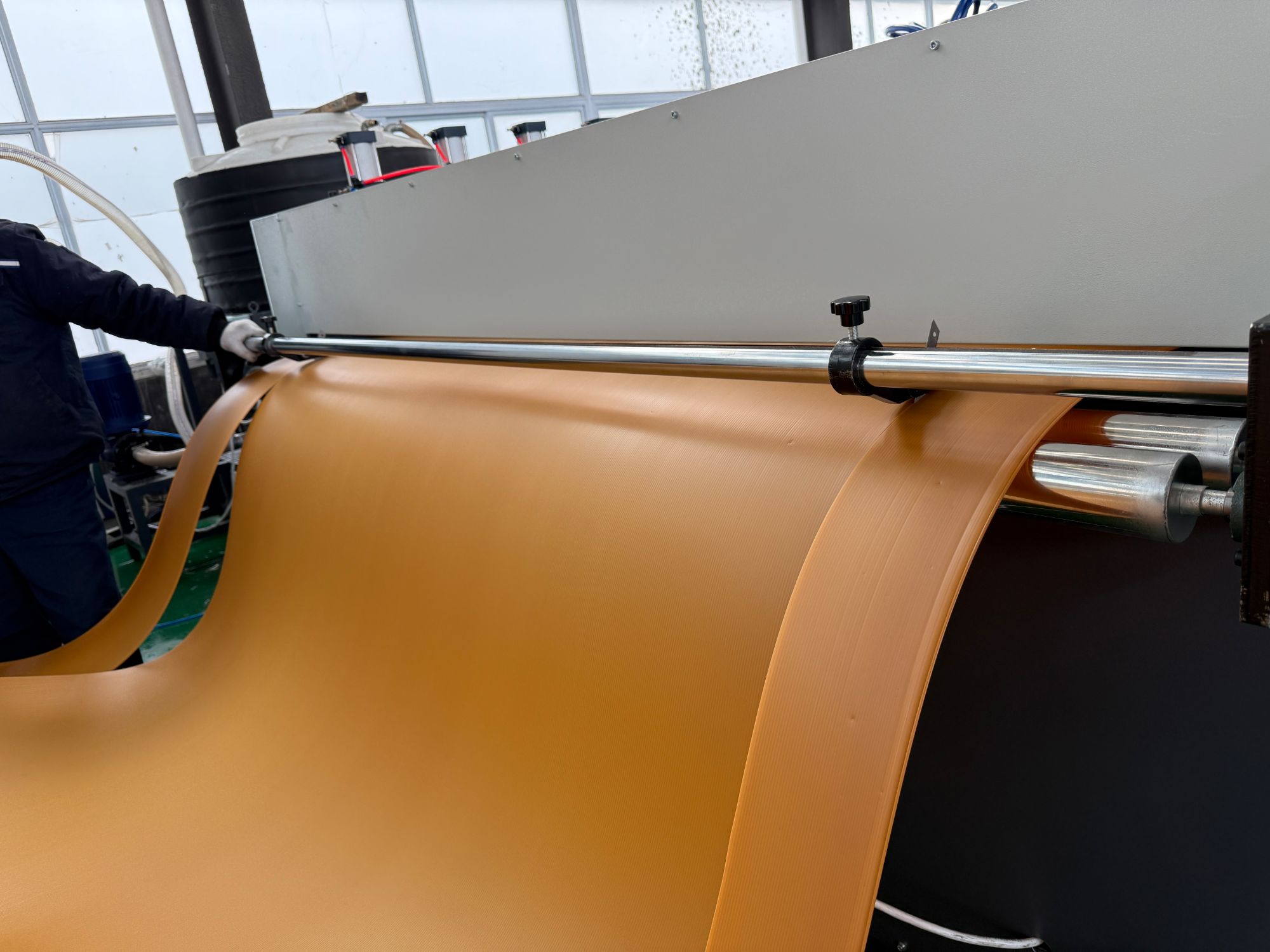
The line starts with a low hum, not a roar. Rolls of aluminum skin and foam core feed into a cutting station where a CNC router shaves each layer to within a tenth of a millimeter. The operator doesn't watch from behind glass; she stands close enough to feel the vibration change when the blade dulls. That small cue matters more than the printout on the control screen.
From cutting, the pieces move through a series of rollers that press adhesive between the skins and the core. The pressure isn't uniform across the whole sheet — it spikes at the edges where delamination usually starts. A second worker runs a gloved thumb along the seam every few minutes, checking for a curl that tells him the cure is off by seconds. If his thumb catches, he stops the belt rather than letting the panel sneak through.
The last station before packing is a light table tilted at forty-five degrees. Panels slide across it while a camera catches faint ripples in the surface that hands might miss. One in every forty is pulled, sometimes for a recheck, sometimes for the recycling bin. That's not a quota; it's just how the line breathes when it's run by people who still look at what they build.
Durability Without the Bulk: The Engineering Behind the Panels
Most people assume a panel has to be thick to be tough. The design here flips that logic. By using a multi-layer composite core with strategic fiber orientation, the panel distributes impact force across its surface instead of letting it concentrate at a single point. That means a slim profile can still shrug off dents, scratches, and everyday collisions that would leave conventional materials looking worn.
The real difference is in the bonding process. Rather than relying on a single adhesive layer, each stratum is fused under controlled pressure and temperature. This creates a continuous load path from the outer skin to the inner core, eliminating weak interfaces where delamination typically starts. The result is a panel that resists flex fatigue and keeps its shape even after years of thermal cycling.
Weight savings come from what’s not there. Honeycomb voids and micro-ribs remove unnecessary mass while preserving structural rigidity, much like the internal geometry of a bird’s wing. It’s a balance that allows for easier handling and installation without compromising long-term resilience. That’s why the panels feel surprisingly light yet respond like something far more substantial.
The Machinery That Keeps Every Grid Cell Perfectly Formed
Under the hood, a grid container doesn't simply place items into a fixed set of boxes. It runs a two-step process: first, it resolves track sizes from the available space, the content's min-content and max-content contributions, and any explicit track definitions. Then it assigns each grid item to a cell based on source order, automatic placement rules, and any named lines or areas. This dual pass keeps every cell's width and height stable across different screen sizes, because the same calculations happen every time the container's dimensions change.
The fr unit plays a central role in that stability. When you declare something like 1fr 2fr, the grid engine subtracts gaps and fixed tracks from the available space, then distributes the remainder according to the flex factors. But the machinery doesn't stop there. minmax() lets you set a lower bound so a cell never collapses below a readable size, while auto-fit and auto-fill decide how many repeatable tracks actually get created. That's why a set of cards can shift from four columns to two without any cell looking stretched or squeezed beyond its content's natural shape.
Alignment properties such as justify-items and align-items only affect content inside each cell, not the cell itself—unless you use stretch, which is the default. The implicit grid also has its own sizing rules: any item placed outside the explicit rows or columns triggers the creation of new tracks sized by auto, which pulls from the largest item in that row or column. This fallback behavior means even unplanned placements produce a cell that matches the visual rhythm of the rest of the grid, no manual fixes required.
From Standard Sizes to Custom Grids: Matching Your Exact Specs
Standard grid sheets rarely fit odd-shaped projects, leaving awkward cuts or wasted material. A square pattern that looks right on paper often forces compromised layouts once real measurements hit the floor.
Custom grids remove that guesswork by mirroring your exact dimensions from the start. Instead of adapting a preset, you define spacing, line weight, and corner treatment so the framework matches the physical space without trimming or stretching.
This approach keeps alignment consistent across doors, windows, or fixture placements. The result is a cleaner install where every element sits precisely where intended, without the visual noise of mismatched intersections.
Cutting Waste and Boosting Speed on the Factory Floor
On many factory floors, waste hides in plain sight—extra steps between a workstation and a shared tool crib, parts staged too far from the line, or operators waiting on a forklift that never seems to arrive. Cutting that waste rarely calls for big capital. It comes from walking the actual path a product takes, timing the pauses, and relocating the small things that cause the biggest delays. When a team moves a torque wrench closer to the assembly point or rearranges a bin so the next part sits at arm’s reach, cycle time drops without anyone working harder. Speed follows waste removal almost automatically.
The fastest improvements often start with the people who run the machines and handle the parts. A five-minute huddle at shift start, focused on one bottleneck from the previous day, can surface fixes that a distant planner would never see. Simple visual cues—a taped outline for a pallet, a colored tag that flags a low-bin condition—keep material flowing and prevent the stop-start rhythm that drains a shift. Teams that track downtime on a whiteboard and assign a quick action before the next break tend to build momentum. Waste gets cut not because someone issued a mandate, but because the floor itself becomes wired to remove friction in real time.
FAQ
The line is built to produce PP hollow grid boards, often called corrugated plastic sheets or fluted polypropylene panels. These boards feature a twin-wall or multi-wall structure with hollow channels running through the middle, making them ideal for applications where a balance of rigidity and low weight is needed.
The hollow grid structure creates a series of internal ribs that act like I-beams, providing high bending stiffness while the empty cells reduce material usage. This design resists impact, moisture, and most chemicals, so the panels stay durable even under rough handling or outdoor exposure, yet remain light enough for easy transport and installation.
These boards show up in packaging, automotive interiors, construction signage, reusable containers, agricultural protection, and advertising displays. Because they are lightweight, waterproof, and printable, they serve as a practical replacement for cardboard, wood, or solid plastic sheets in many temporary or semi-permanent applications.
Advanced features include precision temperature control across multiple zones, specialized calibration units for uniform cell formation, automated cutting and stacking systems, and quick-change die heads for different board widths or thicknesses. Many lines also integrate real-time thickness gauging and scrap regrinding, which reduces waste and improves consistency.
Yes, most manufacturers offer modular configurations. You can adjust die lips and calibrator blocks for thicknesses typically ranging from 2 mm to 12 mm, add masterbatch dosing for custom colors, and choose embossing rollers or anti-slip coatings. Some systems support co-extrusion for a stiffer skin layer on one or both sides.
The primary raw material is polypropylene, either virgin or recycled, often blended with calcium carbonate or impact modifiers to tune stiffness and cost. Additives such as UV stabilizers, anti-static agents, and flame retardants can be introduced through side feeders or masterbatch units, depending on the end-use requirements.
Modern lines use servo-driven extruders and optimized barrel heating to reduce power consumption by 15-25% compared to older hydraulic systems. Heat recovery from the cooling section can preheat raw material, and closed-loop water cooling minimizes water usage. These improvements lower operating costs while maintaining stable output.
Typical support includes installation supervision, operator training, spare parts supply, and remote troubleshooting. A good manufacturer also provides process recipes for different board grades, periodic maintenance checklists, and upgrade options for automation or higher output. Some offer on-site commissioning and production trial runs to guarantee the line meets agreed specifications.
Conclusion
PP hollow grid boards owe their impressive strength-to-weight ratio to a clever internal structure—interconnected ribs form a matrix of cells that distribute load while keeping material use minimal. Walking through our production line, you see how raw polypropylene pellets are melted, extruded into a flat sheet, then passed through precision calibrators that create uniform hollow channels and cross-ribs. This process locks in rigidity without adding bulk. The engineering relies on controlled cooling and tension, ensuring each cell wall bonds cleanly to the outer skins. The result is a panel that withstands impacts, resists moisture, and springs back from bending, yet weighs a fraction of solid plastic sheet. For manufacturers, this means easier handling, lower shipping costs, and longer service life in demanding applications.
Our advanced machinery keeps every grid cell perfectly formed through multi-zone temperature control and servo-driven nip rolls that maintain exact thickness tolerances. Whether you need standard 4x8 sheets or custom grid spacing, the line adjusts quickly—swap dies, tweak rib pitch, change surface finish—all without sacrificing output. Waste reduction is built into the process: inline recycling grinds edge trim and startup scrap back into the melt stream, while high-speed downstream cutting and stacking minimize downtime between batches. Operators monitor key parameters on a single touchscreen, allowing swift changes between product specs. This combination of precision, flexibility, and efficiency helps converters deliver durable, lightweight panels that meet tight deadlines and exact customer specs.
Contact Us
Contact Person: LISA LEE
Email: [email protected]
Tel/WhatsApp: +86 13780696467
Website: https://www.qdpipemachine.com