
Healthcare Thermal Printable Wristband Factory: Premium Quality and Custom Solutions
2026-11-16
In healthcare, even the smallest details can have the biggest impact—wristbands included. A smudged barcode or a torn band doesn’t just slow down workflows; it risks patient safety. That’s where precision manufacturing makes all the difference. At BAOBI, we combine premium materials with tailored thermal printable solutions to meet the strict demands of hospitals and clinics. Here’s a look at how the right wristband factory turns a simple accessory into a reliable tool for accurate identification, comfort, and compliance.
How Durable Wristbands Support Patient Safety in Hospitals
A wristband that fades or tears after a few days of use can quickly become a liability. In a busy hospital, barcodes and printed patient data need to survive constant handwashing, bed baths, and the friction of bedsheets. Durable materials, like multi-layer thermal composites or reinforced synthetics, resist moisture and abrasion so that critical identifiers remain sharp. When a nurse scans a code at 3 a.m. for medication administration, there is no room for guesswork—every scan must succeed the first time, directly guarding against mix-ups.
Wristbands also play a quiet but crucial role in fall prevention and allergy alerts. A color-coded, high-durability band that stays intact even if a patient becomes agitated or confused is a constant visual prompt for staff. It signals “fall risk” or “latex allergy” without slowing down care, and it doesn’t rely on memory or a chart that might be out of sight. The resilience of the band ensures that these warnings aren’t lost in the chaos of an emergency situation, where every second counts.
Beyond the technical side, durable wristbands contribute to patient trust. A band that stays legible and securely fastened for an entire admission reduces the need to replace it repeatedly—a process that can be uncomfortable and disorienting for someone already feeling vulnerable. Fewer reprints also mean fewer opportunities for identification errors at the admission desk. When patients see a well-made, intact wristband on their own arm, it subtly reinforces that the hospital sweats the small stuff, which is exactly what safety demands.
The Making of Skin-Friendly Thermal Print Wristbands
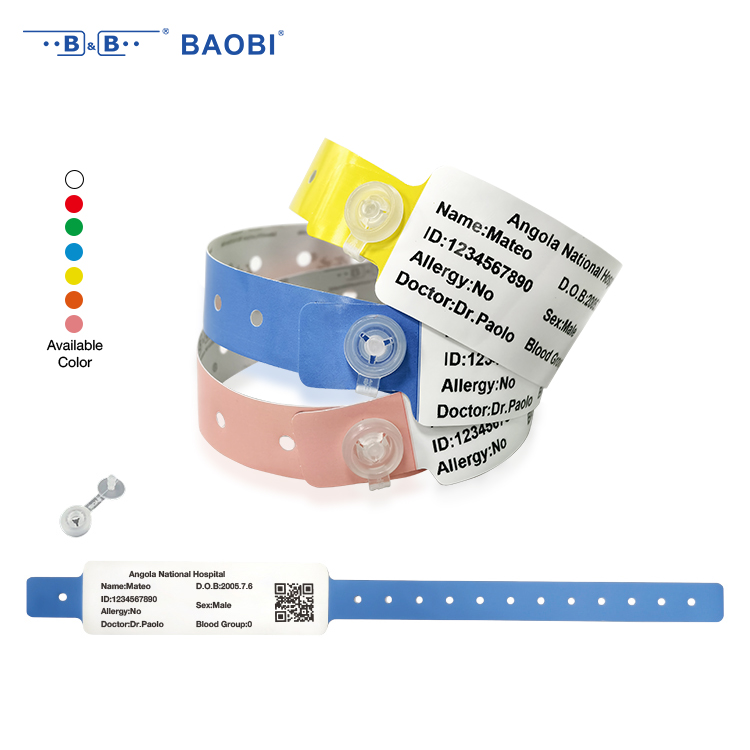
Every skin-friendly wristband begins with an obsessive deep dive into materials. Instead of defaulting to standard plastics that can trap moisture or leach irritants over time, we source medical-grade thermoplastic polyurethanes that breathe almost like a second skin. These TPUs are selected not just for their softness but for a lack of latex proteins and common accelerators, which means no angry red marks after hours of wear. Each roll destined for our thermal printers undergoes a porosity check and a 48-hour direct contact assay on sensitive skin patches, long before any printing ink comes into play.
The real quiet breakthrough sits in the coating layer. Most thermal papers rely on developers like BPA or BPS to turn color when heat hits, but we route around those completely by using a vitamin C derivative as the core color activator. This compound, suspended in a microcrystalline wax binder, reacts instantly to the printer’s printhead at lower temperatures, producing crisp, dark text without any of the endocrine-disruption worries. The coating fluid is applied in a dust-free chamber with humidity controls that keep the layer uniform—too thin and the image fades, too thick and it feels gummy against the wrist.
After the wristbands are slit and perforated, they pass through a finishing station that’s equal parts laser edging and human-eyed scrutiny. Each band’s edge is rounded with a cold laser to prevent those micro-nicks that can chafe a newborn’s arm or an adult’s inner wrist during a workout. Then a random sampling from every batch goes into an extended wear trial where team members log real comfort scores across showers, sleep, and exercise. Only when the feedback reads consistently “forgot I had it on” does a production lot get signed off and sent out the door.
Custom Branding That Improves Hospital Workflow
A well-designed brand in a hospital does more than look pretty on a sign. It quietly guides patients, reduces confusion at check-in, and helps clinical teams locate supplies faster when every second counts. By mapping the visual identity to real staff journeys, you stop wasting time on avoidable questions and get back to care.
Subtle cues like color-coded department zones, consistent iconography on equipment, and clearly branded directional systems turn chaotic corridors into intuitive paths. These details make a new nurse’s first week less overwhelming and help patients feel safe even when they’re nervous. The brand becomes a silent assistant, working around the clock without adding a single line to the budget.
The shift happens when internal signs, digital screens, and staff badges all speak the same design language. That consistency cuts down on miscommunication between shifts, supports faster patient discharges, and reinforces safety protocols in a way that feels natural. Instead of training people to navigate the building, you let the environment do the teaching.
Material Choices That Withstand Hand Sanitizers and Showers
Frequent hand sanitizing and daily showers can quietly destroy accessories and surfaces that aren't built to handle constant moisture and alcohol exposure. A ring that looks flawless on day one might develop a cloudy finish, or a bracelet could start irritating your skin after weeks of contact with sanitizer residue. The fix isn't a special coating or a complicated care routine—it starts with picking materials that naturally laugh off these everyday encounters without losing their look or integrity.
Surgical-grade stainless steel, particularly 316L, remains one of the least reactive options for jewelry and watch bands because it shrugs off alcohol, soap, and hard water with zero corrosion. Solid titanium goes a step further, being so inert that it's often used in medical implants and stays completely unaffected by pH swings from cleansers. If you lean toward a warmer tone, solid 14k or 18k gold (not plated) stays true because gold doesn't tarnish or react with ethanol—just be mindful that lower karat alloys may include metals that can dull over time if constantly doused. Silicone, when it's high-grade and free of porous fillers, also handles sanitizers and shower steam remarkably well, though it can trap a film of product that needs a quick rinse.
Steer clear of anything with a thin plating, glued-in stones, or organic materials like leather and untreated wood. These absorb moisture and alcohol unevenly, leading to cracks, discoloration, or that tacky feeling against damp skin. A solid metal band with a simple, polished surface will outlast anything with crevices where sanitizer can pool. In the end, the safest route is to choose materials that don't need to be babied: metals that won't oxidize, synthetics that don't swell, and nothing that relies on a surface finish for its protection. That way, your everyday pieces stay looking intentional—not just clean, but genuinely unchanged by all the cleaning.
Small Batch Orders for Specialized Care Units
Specialized care units rarely fit neatly into one-size-fits-all supply models. A neonatal intensive care bay demands micropore tape and fingertip oxygen sensors that differ substantially from the equipment used in adult trauma rooms. Small batch ordering allows procurement teams to match each unit’s unique clinical workflows with precisely tailored quantities—no more, no less. Rather than bulking up on generalized stock that sits idle, smaller deliveries ensure that hyper-specific catheters, ventilator circuits, or wound care kits arrive on schedule and rotate through inventory before expiry dates become a concern.
When patient acuity spikes without warning, having the ability to adjust orders quickly becomes a quiet advantage. A burn unit suddenly handling multiple admissions can escalate its silver-impregnated dressing needs within a matter of hours, while a cardiac step-down floor can scale back when census drops. These nimble adjustments aren’t merely convenient—they protect delicate budgets from being swallowed by rush fees or overnight courier costs. Clinicians also benefit because the items they reach for most often are never buried under layers of generic supplies meant for the entire hospital.
Beyond the balance sheet, smaller batches help safeguard the environment inside the unit itself. Storage rooms with limited square footage stay uncluttered, making it easier for staff to locate critical items in seconds. Less overstock also means fewer products reaching their expiration date, which reduces the quiet burden of clinical waste. Over time, this intentional approach creates a loop where caregivers trust the system, suppliers understand the unit’s rhythm, and the focus stays where it belongs—on the patients who depend on these highly tailored spaces.
Direct Production Insights from a Wristband Factory Floor
Walking the production floor of a wristband factory reveals things a spec sheet never will. The hum of the injection molding machines, the quick hand movements at the assembly stations, and the subtle ways operators adjust their workflow tell a story about manufacturing efficiency that no report can capture. You notice, for instance, that a slight variation in material temperature can turn a batch of silicone bands from flawless to faulty within minutes. On the floor, that knowledge isn't theoretical—it's felt through experience and shared during shift changes with a nod toward the temperature gauge.
What really becomes clear is how much finishing defines the final product. Rushing through deburring or skipping a polishing pass leaves edges that feel cheap against the skin. The line supervisor doesn’t need a checklist for this; she runs her thumb along the seam of every fiftieth band almost without looking. When a batch comes out with even a whisper of roughness, the whole line pauses. Tools get sharpened or replaced. Nobody writes a memo—it’s just how they keep the defect rate low. That kind of quiet quality control is impossible to schedule into a work order.
There’s also an invisible rhythm to how orders move through the floor. Smaller custom runs of debossed logos or color-matched bands get slotted between the high-volume orders not because anyone planned it that way, but because the older machines need more downtime between material changes. The crew works around this, building a buffer of half-finished parts near the printing station so the newer equipment never starves. It’s chaotic, but in that chaos patterns emerge—patterns that end up being more reliable than the official production schedule pinned to the wall.
FAQ
Our wristbands use a specialized top-coated thermal layer that resists alcohol, hand sanitizers, and frequent handwashing — a detail most suppliers overlook. Instead of fading within hours, our print stays crisp for the entire patient stay, reducing rescanning errors and staff frustration.
Yes, we support custom shapes, tamper-evident closures, and antimicrobial additive integration. You can have a perforated stub for lab samples, barcode placement optimized for your scanners, and even color zones indicating fall risk or allergy — all validated for clinical workflow without adding bulk.
We combine inline barcode verification on every print run with a proprietary ribbon-back coating that prevents static buildup. This dramatically lowers misreads. Real-world testing in busy ERs showed first-scan success rates above 99.7%, even after 72 hours of wear.
We provide a compatibility assessment with your existing HIS/ADT systems, free sample rolls for workflow trials, and on-site training if needed. Our team often helps redesign the wristband layout to accommodate both human-readable text and 2D barcodes without crowding, which streamlines nursing adoption.
Absolutely. We engineered a soft, non-woven fabric variant that breathes and stretches, preventing skin irritation during extended wear. It uses a gentle silicone adhesive and can tolerate showering. The print remains legible for up to 30 days, significantly reducing replacement labor.
Our production lines are modular and can scale to 5 million units per week within 72 hours. We keep strategic buffer stocks in regional hubs, and we prioritize emergency orders with a dedicated fast-track lane. Backing this is a dual-supplier agreement for raw materials to avoid single-point failures.
We've phased out PVC entirely. The core materials are now polypropylene-based, fully recyclable where facilities exist, and the adhesive systems are latex-free. Also, our thermal coating requires no ink ribbons, which eliminates cartridge waste. We're actively working on a compostable version for low-risk areas.
Conclusion
A wristband’s true value in a hospital isn’t just in the printed name—it’s in surviving everything a patient’s day throws at it. That’s why our thermal printable wristbands are built from the ground up with durability that directly protects patient safety: smeared, torn, or faded bands lead to misidentification, and we eliminate that risk with materials that scoff at alcohol-based hand sanitizers, constant handwashing, and warm showers without losing legibility. But toughness means nothing if the band irritates skin during a days-long stay. Our production floor prioritizes skin-friendly, non-latex layers that are soft and breathable, micro-coated to prevent chafing, so comfort and resilience work together rather than against each other.
Beyond the band itself, every order is treated as a tailored solution because no two care units work the same way. We embed hospital logos, barcodes, and color codes into the wristband design in a way that streamlines nurse workflows—no extra stickers, no mismatched labels. Specialised departments like NICUs or oncology wards frequently need small, custom-sized batches with unique copy or specific adhesive-free closures, and our direct-from-factory setup handles these without forcing a minimum that doesn’t fit. Walk onto our factory floor and you’ll see in-house die-cutting, printing, and coating lines working in unison for short lead times and total quality oversight, making those quick-turn, limited-run orders not just possible but practically effortless.
Contact Us
Contact Person: Bill Xu
Email: [email protected]
Tel/WhatsApp: 8618688898707
Website: https://www.baobitech.com/