
Current Sense Resistor Manufacturers for Precision Circuit Design
2026-11-03
Precision circuit design lives or dies by the components you trust to measure current accurately. Choosing the right current sense resistor manufacturer is rarely a simple checkbox—it’s about balancing tolerance, thermal stability, and long-term drift under real operating conditions. While many suppliers claim precision, few deliver the repeatable performance that high-accuracy analog front-ends demand. That’s where Milliohm comes into focus: a manufacturer that treats low-ohm sensing not as an afterthought, but as the core of its engineering philosophy. In this article, we’ll explore what separates reliable current sense resistor makers from the rest, and why material choice, layout, and manufacturing consistency matter more than datasheet headlines.
Beyond the Datasheet: How Top Suppliers Approach Low-Temperature Coefficient Resistors
A datasheet gives you a single temperature coefficient figure, but seasoned resistor makers know real drift rarely follows one clean slope. They characterize resistance change across the actual operating window, often at several temperatures and under realistic load. The point is to expose nonlinear behavior—such as a parabolic shift that only appears at the cold end—that a simple ±25 ppm/°C line would mask.
Material and process control is where the difference gets concrete. Leading vendors tweak annealing cycles, trim geometry, and sometimes laser-adjust individual parts after thermal cycling. The aim is not just a nominal TCR at room temperature, but a tighter drift envelope after years of field stress. Batch data—oven profiles, post-trim shifts, and occasional teardown results—frequently accompanies the qualification package rather than staying locked in an internal database.
It is also worth asking for split-lot validation and matched sets. A supplier that takes low-TCR work seriously will provide ratio tracking over temperature, not merely absolute tolerance. In precision dividers and instrumentation front ends, two resistors shifting together by 2 ppm is far less harmful than one moving independently by 5 ppm. Getting that data before the design freeze separates companies that engineer for stability from those that just quote a number.
The Hidden Tradeoffs in Metal Alloy vs. Metal Foil Current Sensing
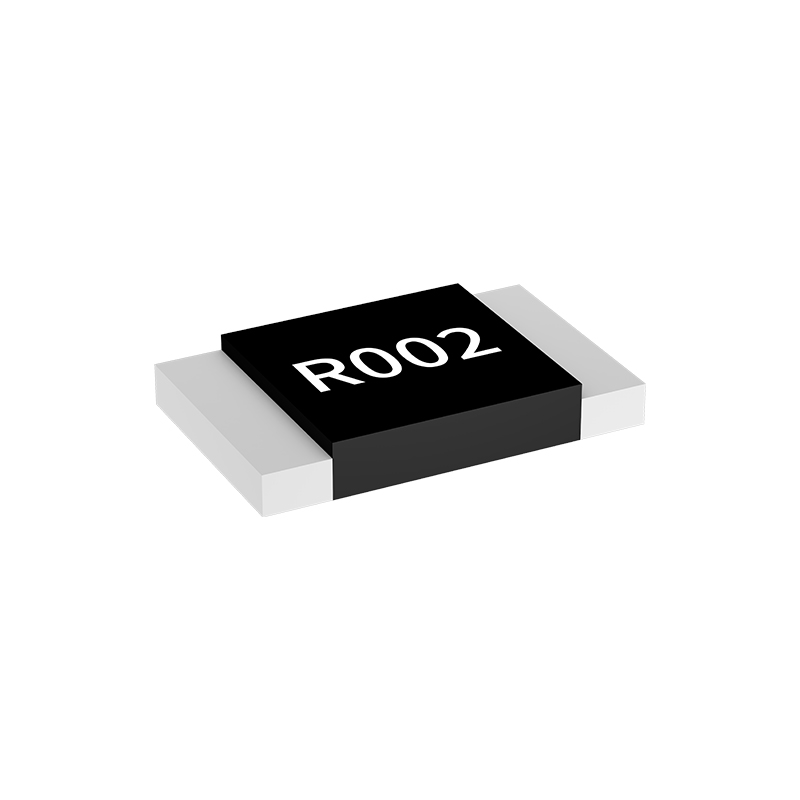
Metal alloy current sense resistors often seem like the straightforward choice until you examine how their temperature coefficient of resistance behaves under pulsed loads. The alloy's bulk resistivity shifts unevenly across the element, creating hot spots that quietly degrade measurement linearity over time. This drift isn't always visible in short-term validation, so designers end up accepting an accuracy penalty they never explicitly signed off on.
Metal foil, by contrast, uses a patterned resistive layer bonded to a ceramic substrate. The real tradeoff is rarely discussed: foil's excellent thermal EMF performance comes at the cost of mechanical fragility near the termination edges. Repeated thermal cycling can induce micro-fractures that increase resistance by a few milliohms—negligible in a lab, disastrous in field equipment that operates across wide ambient swings.
What's often missing from datasheet comparisons is the parasitic inductance difference under high di/dt conditions. Alloy resistors, especially thick-film variants, can exhibit internal inductance that turns a nominal 1 mΩ sense element into a small but meaningful voltage spike generator. Foil parts with Kelvin terminations manage this better, but their higher unit cost forces a system-level negotiation between front-end filtering complexity and long-term measurement stability.
When Board Space Shrinks: Sourcing Precision Resistors for Compact Power Stages
As power stages pack more phases into shrinking voltage regulator modules, resistor real estate becomes a critical constraint. The traditional 0805 current-sense resistor simply no longer fits when the controller, drivers, and MOSFETs sit on a board area measured in square millimeters rather than square centimeters. Designers are forced to look at 0402 and even 0201 packages, but shrinking the footprint isn't a free lunch: tolerance, temperature coefficient of resistance (TCR), and power dissipation all become harder to maintain.
A practical approach starts with matching the resistor technology to the measurement function. Thin film resistors offer tight initial tolerance and low TCR in small sizes, but their power ratings drop quickly below 0402. For current sensing in dense power stages, metal alloy or metal strip resistors often beat thin film because they handle higher power density and provide low resistance values without sacrificing stability. However, board layout matters just as much as the component itself—poor thermal relief or via placement can negate the precision of even the best resistor.
Sourcing for compact power stages should prioritize vendors who supply characterization data at actual operating temperatures, not just room temperature. Look for datasheets that include derating curves for 0201 and 01005 footprints, and ask for long-term stability under pulsed load conditions. While it is tempting to standardize on a single resistor family for all sensing nodes, mixing technologies based on the specific node—voltage feedback, current sense, or gain setting—often yields a smaller total footprint without compromising accuracy.
Thermal EMF and Drift: What Premium Manufacturers Actually Test
Thermal EMF doesn't show up on a basic datasheet sweep. Premium manufacturers run a dedicated test where the device sits in a thermally stabilized chamber, all external junctions are kept isothermal, and the residual voltage is sampled before and after reversing the excitation current. They aren't looking for a single number; they're mapping how the offset changes across a 5°C to 40°C window, often in 0.5°C steps. The result is a per-unit thermal signature, not a calculated worst-case guess.
Drift testing is just as deliberate. Instead of accelerated bake-and-extrapolate shortcuts, these labs hold the part at several fixed temperatures for hundreds of hours, logging continuously with a nanovoltmeter. They separate reversible temperature coefficients from true long-term drift by cycling back to a reference temperature every 24 hours. Any unit that shows a monotonic creep beyond a few microvolts gets rejected or binned, even if it technically falls inside the broad datasheet limit.
What sets the best manufacturers apart isn't the existence of these tests, but the willingness to share raw data. Rather than hiding behind a single "typical" curve, they'll ship a calibration report showing the exact thermal EMF slope and drift rate for your serial number. That level of transparency only works when the test setup itself is reproducible, with guarded connections, low-thermal solder, and a documented soak time before each reading.
From Battery Management to Motor Drives: Matching Resistor Specs to Real Loads
Resistors rarely get the attention they deserve until a board comes back from the field with burn marks. In battery management systems, the job splits into two very different regimes: high-precision voltage sensing where drift is the enemy, and passive balancing where a resistor is asked to shed real energy as heat for hours. A 1% tolerance part might be fine for a current-sense divider, but the same resistor placed across a Li-ion cell during balancing has to survive continuous dissipation at elevated ambient temperatures. Derating curves and thermal impedance to the copper plane often matter more than the nominal ohm value printed on the reel.
Motor drives flip the problem on its head. Gate resistors see short, sharp current pulses rather than steady load, so pulse-withstand rating and parasitic inductance dominate. A 2512 thick-film part that works perfectly as a BMS bleed resistor can fail catastrophically as a snubber or gate-drive damping element because the instantaneous energy is dumped in microseconds, not minutes. Spec sheets list a maximum pulse energy number, but that figure assumes a given pulse width and ambient temperature; a 50 W repetitive pulse at 1 kHz is a very different thermal reality than a single 50 W event once per second.
Matching resistor specs to real loads therefore starts with measuring the actual waveform, not the average power. Capture the peak current, the duration, the repetition rate, and the ambient temperature inside the enclosure. Then look past the headline resistance and tolerance: check the temperature coefficient for sensing circuits, the voltage coefficient for high-voltage dividers in inverters, and the surge capability for anything connected to a DC bus. In practice, a wirewound part with higher inductance may be fine for a low-speed battery balancer but questionable in a fast-switching motor phase leg. The goal is to pick a resistor that survives the worst-case transient while still fitting the thermal and mechanical constraints of the board.
Qualifying a Resistor Partner for High-Reliability Analog Front Ends
A resistor that looks perfect on a datasheet can fall apart inside a precision front end. Long-term drift under low-level bias, voltage coefficient at small signal swings, and the way moisture ingress shifts thin-film stability often matter more than the nominal tolerance printed in the catalog. When evaluating a partner, ask for characterization data from parts aged at elevated temperature and humidity, not just typical curves. A supplier who treats those tests as standard practice is already ahead.
Lot-to-lot repeatability is where many resistor programs quietly fail. High-reliability analog front ends depend on stable gain and offset, so even a few ppm of resistance shift after reflow or thermal cycling can push a channel out of spec. The right partner maintains tight process controls on sputtering, laser trimming, and passivation, and can show SPC data across years rather than a single qualification report. Request samples from three or more non-consecutive production lots and measure them under the actual bias and temperature profile of your circuit.
Beyond the parts themselves, the relationship matters once a field return lands on your desk. A capable resistor vendor offers failure analysis that goes deeper than a certificate of compliance. They can help separate manufacturing defects from application stress, suggest alternative materials or geometries, and work with you on custom matched networks or divider ratios that reduce front-end error. If the partner treats your board-level parasitic effects as their problem too, qualification becomes a lot less painful.
FAQ
Tolerance and temperature coefficient of resistance (TCR) usually dominate, but don't overlook long-term drift, thermal EMF, and the availability of four-terminal Kelvin packages. A supplier that provides detailed pulse and derating curves in the datasheet tends to be more reliable for high-stability designs.
Vishay's WSLP and WSK series, Susumu's KRL and RL series, and Isabellenhütte's BVx and CMx lines are common starting points. Bourns and TT Electronics also have solid metal strip and foil options, especially for cost-sensitive projects that still need low drift.
Thermal EMF creates a small voltage offset across the resistor when temperature gradients exist, which can swamp the tiny sense voltage. TCR changes resistance with temperature, directly altering the gain. Good precision resistors use materials like manganese-copper or nickel-chromium and symmetric pad layouts to keep both effects small.
In a two-terminal resistor, lead and solder resistances add to the sense element, causing errors at milliohm values. Four-terminal Kelvin connections separate current path from voltage sensing path, so the measured voltage reflects only the element resistance. This is essential when you need better than 1% system accuracy.
It indicates the part has passed automotive-grade stress tests for temperature cycling, humidity, thermal shock, and board flex. Even outside automotive, this screening gives confidence in harsh industrial or outdoor environments, and many manufacturers will list AEC-Q200 compliance for their precision series.
Metal foil offers the lowest TCR and best stability but costs more and takes more board space. Metal strip handles high current and has low resistance with good pulse tolerance. Thick film is cheaper and smaller, but its TCR and noise are higher, so it suits less critical monitoring rather than true precision work.
Footprint and pad compatibility are the first issue: the same 2512 package can have different terminal shapes or power ratings. TCR and thermal resistance also vary enough to shift accuracy at high load. Locking a single series from one supplier and sticking with it across prototypes and production avoids many last-minute calibration surprises.
Conclusion
Choosing a current sense resistor manufacturer for precision circuit design rarely comes down to a single datasheet number. Leading suppliers push beyond nominal TCR by characterizing resistance shift across the entire operating range, including pulse loading and board-level strain. Metal alloy parts offer low resistance values and high power density, but their thermal behavior under sustained current can vary more than a well-made metal foil element. Foil, in contrast, delivers extremely tight initial tolerance and near-flat temperature response, yet the tradeoff often appears in size and cost—especially when a compact power stage leaves no room for a bulky through-hole component. When board space shrinks, the practical question becomes how well the resistor sheds heat through its terminations and PCB copper, not just what the free-air rating claims.
Thermal EMF and long-term drift are where premium manufacturers separate themselves. Rather than relying on generic JEDEC tests, they run application-specific thermal cycling, humidity exposure, and load-life tests with Kelvin connections to catch micro-ohm-level instability. In battery management and motor drives, the load is rarely steady: pulsed currents, inrush spikes, and ambient temperature swings can expose hidden weaknesses in element materials and terminations. For high-reliability analog front ends, qualifying a resistor partner means looking at process control, batch-to-batch consistency, and whether the vendor shares raw test data—not just polished sample reports. A supplier that understands the actual current profile of your design will help you avoid over-specifying or, worse, discovering drift only after field failures begin.
Contact Us
Contact Person: Yuying Gao
Email: [email protected]
Tel/WhatsApp: +86 18926013721
Website: https://en.milliohm.net/