
China RCCB Guide: Choosing Safe Residual Current Circuit Breakers for Your Needs
2026-11-02
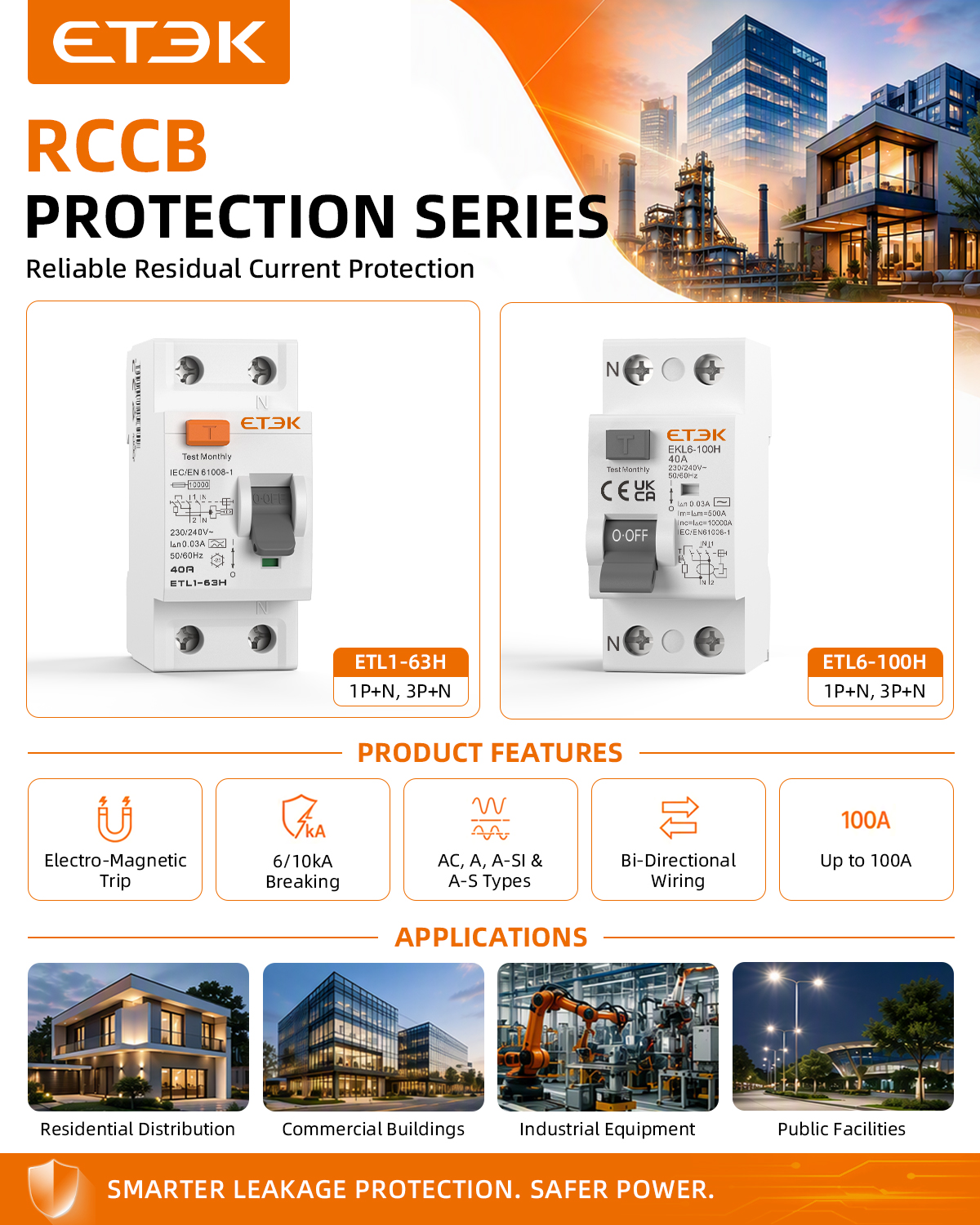
Residual Current Circuit Breakers (RCCBs) are your silent guardians against electric shock and fire—yet choosing the right one in China’s vast market can feel like navigating a maze of standards and specs. This guide cuts through the confusion, offering practical tips for matching RCCB ratings, types, and features to your exact needs. Whether you're an electrician, facility manager, or homeowner, you'll discover how to balance safety, compliance, and cost without overspending. For reliable, certified options that meet both Chinese GB and international IEC standards, check out ETEK—a brand trusted for robust protection in residential and industrial settings. Read on to make an informed choice and keep every circuit safe.
Which RCCB Class Actually Fits Chinese Home Wiring
Surge currents in Chinese residential circuits are not a minor footnote—they are the exact reason why AC-type RCCBs fail silently. Most modern homes run washing machines, inverter air conditioners, and switch-mode power supplies, all of which inject smooth DC residual currents under fault conditions. An AC-type unit simply won't trip on these, leaving a false sense of safety behind the breaker panel. A-type devices, by contrast, are designed to detect pulsating DC and are far better matched to what actually flows through a typical Chinese apartment's wiring.
That said, not every outlet demands the same protection level. For a kitchen where you run an induction cooker and a fridge with a variable-speed compressor, an A-type RCCB is the practical floor. For older bathrooms with only a water heater and basic lighting, a well-chosen AC-type might still hold up, but most electricians now recommend skipping AC altogether—the price difference has narrowed enough that going straight to A-type avoids premature replacement when a new appliance arrives.
The honest answer is that class selection should track the load profile, not just habit. If the home has any DC-capable appliance or a growing list of smart devices, choose A-type and stop second-guessing. Reserve AC-type only for dedicated circuits feeding purely resistive loads like electric radiators or old-style incandescent lighting. Wiring standards in China are shifting, and the safest bet is to match the RCCB class to the real fault signature, not to the cheapest label on the shelf.
When a 30mA RCCB Still Won't Save You from a Shock
A 30mA residual current device is tuned to catch leakage currents that pass through the body to earth, but it won't react if the fault path doesn't actually cross it. Grabbing live and neutral at the same time, for example, leaves the RCCB blind because the current in and out stays balanced. The shock still happens, and the device never sees a reason to trip.
The same blind spot appears with DC or high-frequency leakage. Standard RCCBs are built around 50/60Hz AC waveforms, so a smooth DC fault or a high-frequency component can prevent the core from sensing enough residual flux. Some circuits also introduce upstream faults on the supply side of the RCCB, where the device physically cannot interrupt the current.
Age and mechanical wear matter too. A 30mA trip rating means nothing if the internal contacts are welded, the test button hasn't been exercised in years, or the installation is miswired. In all these cases, the device remains silent while the body completes the circuit.
The Certification Mark Many Buyers Overlook in China
While most importers know to look for the mandatory CCC mark on electronics and automotive parts, the voluntary CQC mark often slips through the cracks. That’s a costly oversight. The China Quality Certification Centre issues the CQC mark for products that go beyond basic safety requirements, covering things like energy efficiency, electromagnetic compatibility, and even performance under harsh conditions. A supplier holding CQC certification has typically invested in higher-grade components and stricter production controls—details that rarely show up in a standard factory audit but directly affect your return rate.
Picture this: two identical-looking LED drivers arrive from different factories. Both carry the CCC logo, so your customs broker clears them without a second thought. Yet one batch starts flickering within six months, while the other runs quietly for years. The difference? The second factory quietly pursued CQC certification for its driver’s thermal management and surge protection—features the CCC test doesn’t even measure. If you’re not explicitly asking for the CQC test report, many suppliers will happily leave it out of the quote, since the certification costs them extra and slows down production.
Adding a simple line to your RFQ—“please attach CQC test reports for all electrical components where applicable”—changes the game. It filters out the low-tier trading companies and signals that you understand the local certification landscape. Better yet, ask for the CQC certificate number and verify it on the official database yourself. That single step has saved more than one buyer from a container of products that met the letter of the law but failed in the real world. The CQC mark isn’t mandatory, which is exactly why it separates serious manufacturers from those doing the bare minimum.
Why Oversizing Your RCCB Can Leave Circuits Unprotected
An RCCB's rating is not about the current it can carry but the residual current level at which it trips. When you replace a 30mA device with a 100mA or 300mA model, the protection threshold shifts dramatically. A leakage of 50mA, which is already enough to cause serious harm or start a fire, will not trip the larger breaker. As a result, circuits that should have fast personal protection are left operating with only a much higher, less sensitive cutoff that may never react to the early stages of a fault.
Oversizing is often done to reduce nuisance tripping from cumulative leakage or electronic loads, but this decision quietly masks developing problems. Damaged insulation, moisture ingress, or a failing appliance can continue leaking current well below the oversized RCCB's trip level. By the time a 100mA or 300mA device finally responds, the fault may be far more advanced, raising fire risk and removing the safety margin for anyone touching a live conductor. Most wiring rules only allow higher-sensitivity RCCBs on final circuits for a specific, assessed reason—not as a shortcut to avoid investigating the cause of unwanted trips.
Wiring Habits That Keep Your RCCB from Tripping When It Should
A frequent culprit is sharing the neutral wire between circuits. When the RCCB monitors the live and neutral conductors, any borrowed neutral creates an imbalance that the device interprets as leakage. If that shared path bypasses the sensing coil, real earth faults can go completely unnoticed. You end up with an RCCB that stays silent during a genuine shock risk because the return current takes a route it was never designed to measure.
Another habit that defeats the protection is connecting the earth and neutral bars together inside a downstream distribution board. This gives fault current a low-resistance loop that does not pass through the RCCB's toroid in the expected way. The device sees a balanced load rather than a leakage path, so it holds the contacts closed when it should drop them instantly. Keeping neutral and earth strictly separate after the RCCB is the only way to preserve its ability to sense the difference between normal return current and a dangerous fault.
Testing Your RCCB Without Falling for a False Sense of Security
Many homeowners press the test button monthly, hear the snap, and assume protection is intact. That snap only confirms the internal mechanism can trip under a simulated imbalance—it says nothing about whether the device will actually disconnect within the required time or at the correct residual current when a real earth fault occurs. A false sense of security grows when this routine is treated as a full functional check.
To get a clearer picture, use a dedicated RCCB tester that injects known residual currents, typically at half, one, and five times the rated trip current. Half-rated current should not trip the device, while rated current should trip within 300 ms and five times rated within 40 ms under standard conditions. Without measuring these trip times, you cannot spot a sluggish mechanism, corroded contacts, or incorrect wiring that the test button ignores.
Also test the RCCB while normal loads are connected, not just in isolation. Some faults only appear under real load conditions—vibration, temperature rise, or neutral-to-earth voltage shifts can affect performance. Keep a simple record of trip times and any noticeable delays; if the numbers drift toward the upper limit, replace the unit instead of assuming it still protects you. Real confidence comes from measured behavior, not from a button that always says everything is fine.
FAQ
An RCCB constantly compares the current flowing through the live and neutral conductors. If the difference exceeds its sensitivity rating, it disconnects the circuit within milliseconds. In Chinese apartments where older wiring may lack proper earthing, this fast response is often the main defence against electric shock from damaged insulation or faulty appliances.
Look for the CCC (China Compulsory Certification) mark and confirm the device complies with GB 16916.1 for standalone RCCBs or GB 16917.1 if it includes overcurrent protection. These standards mirror the core requirements of IEC 61008 and IEC 61009, but the CCC mark is what local inspectors and insurers recognise.
Type AC only responds to sinusoidal AC leakage currents, which is fine for simple resistive loads like incandescent lamps or old heaters. If your home has inverter air conditioners, variable speed washing machines, EV chargers, or any electronics with rectified DC circuits, a Type A RCCB is needed because it detects pulsating DC residuals that Type AC can miss.
Use 30mA for circuits supplying socket outlets, bathrooms, kitchens, and outdoor areas, because this threshold protects people from dangerous shock currents. Reserve 100mA or 300mA ratings for the main incoming supply or sub-distribution boards where the main goal is fire prevention rather than personal protection. Never install a 30mA device upstream of a 100mA device if you want selective tripping.
Legally, residential electrical work in China should be done by a certified electrician, particularly for changes to the distribution board. Even if you understand the wiring diagram, the physical installation involves checking earthing quality, torqueing terminals correctly, and verifying insulation resistance. A licensed electrician also takes responsibility for compliance with GB 50303 and local building codes.
A 2P RCCB switches both line and neutral and is the standard choice for single-phase 220V homes, which cover most apartments and villas. A 4P RCCB is for three-phase 400V supplies, needed only if you run heavy equipment like a central air conditioning compressor, a three-phase lift, or a workshop machine. For a normal flat, a 2P device is simpler and cheaper.
Press the test button at least once every three months, though monthly is better in humid coastal regions like Guangdong or Fujian. The test button injects a simulated leakage current through the detection circuit, verifying that the mechanical trip mechanism is not stuck and the electronics are still responsive. It does not confirm the earthing system is healthy, so a separate earth loop impedance test by an electrician is still needed.
Conclusion
In China's residential wiring landscape, selecting a residual current circuit breaker involves more than matching amperage. The RCCB class must align with local earthing systems—typically TN-C-S or TT—where a Type AC unit often falls short against pulsating DC faults from modern electronics. A 30mA rating is widely treated as a safety floor, yet it cannot prevent a shock between live conductors or save someone already in the grip of a fault; it only limits the duration once earth leakage occurs. Buyers frequently overlook the CCC mark, which is non-negotiable for legal installation, while an oversized RCCB may never trip on small leakages that still pose a fire risk.
Wiring habits often defeat the device itself: shared neutral bars, crossed circuits, or a missing functional earth on electronic breakers can prevent tripping exactly when it should happen. Regular testing with the integral test button only proves the mechanism works, not that the installation is sound—so a dedicated leakage clamp meter and periodic inspection of actual trip times offer a far more reliable picture. Ultimately, choosing a safe RCCB in China means matching the class to real fault currents, respecting the certification system, and verifying the whole circuit rather than trusting a single component.
Contact Us
Contact Person: Andy
Email: [email protected]
Tel/WhatsApp: +86 13356133008
Website: https://www.etek-china.com/